
Culturally Responsive Pedagogy and the use of world language songs
Click here to hear this blog post read in Jess’ voice.
We use a good amount of Spanish language music in our classrooms, and Jon and I have been writing bilingual English/Spanish songs for our students. There are a number of good reasons why we do these things. The first and most obvious one is that many of our students and classroom staff in Springfield, Massachusetts, USA speak Spanish at home and in the community. When we sing songs in Spanish, these kids see themselves, their families and their community reflected in their adaptive music class content, and that helps to affirm their identities and demonstrate that they belong unconditionally.
Other kids might not speak Spanish at all, but they know, respect, or love someone who does, and that connection leads to extra interest in the activity. Some kids might just be interested in the sounds of a different language. Others who don’t speak it might be able to focus better on musical elements without the interference of language comprehension. There are simply a range of reasons that using a world language might help to enhance music instruction engagement in different ways for different learners.
When we bring in songs from other cultures or sources, our team takes care to name the country or ethnic group of origin. Springfield has the largest Puerto Rican population in the state, but our Spanish-speaking students also have roots in Dominican Republic, Mexico, Cuba and other countries. Even though these places share a language, the language varies from place to place. The distinctions matter. Along with our fabulous colleague I-Shea from the Community Music School of Springfield, we developed visuals about several cultures of origin so that when we introduce a song from Dominican Republic, for example, we can show pictures of the landscapes and the people and the art practices and read a few facts (we can say honestly “I don’t know everything about this place, but some things I do know are…”) to help students understand that the song they’re about to hear comes from a different, interesting place and from real people. Many of our students are highly visual and like to deeply engage with the pictures. Anecdotally, we have noticed that those who do, tend to also deeply engage with the music activity immediately afterward. Making those cultural connections explicit helps to cultivate student interest in the musical content.
Because we believe that adaptive music education values both musical and non-musical outcomes, some of the bilingual songs that Jon and I have been writing are structured specifically to teach Spanish words to non-Spanish speakers while promoting musical growth. One movement song teaches students to echo the refrain, “I am a penguin; yo soy pingüino.” Another song repeats the nouns three times in each language on the same melody (gato gato gato/kitty kitty kitty, sol sol sol/sun sun sun) to help reinforce that vocabulary and use repetition to make the unfamiliar language easier for children to sing.
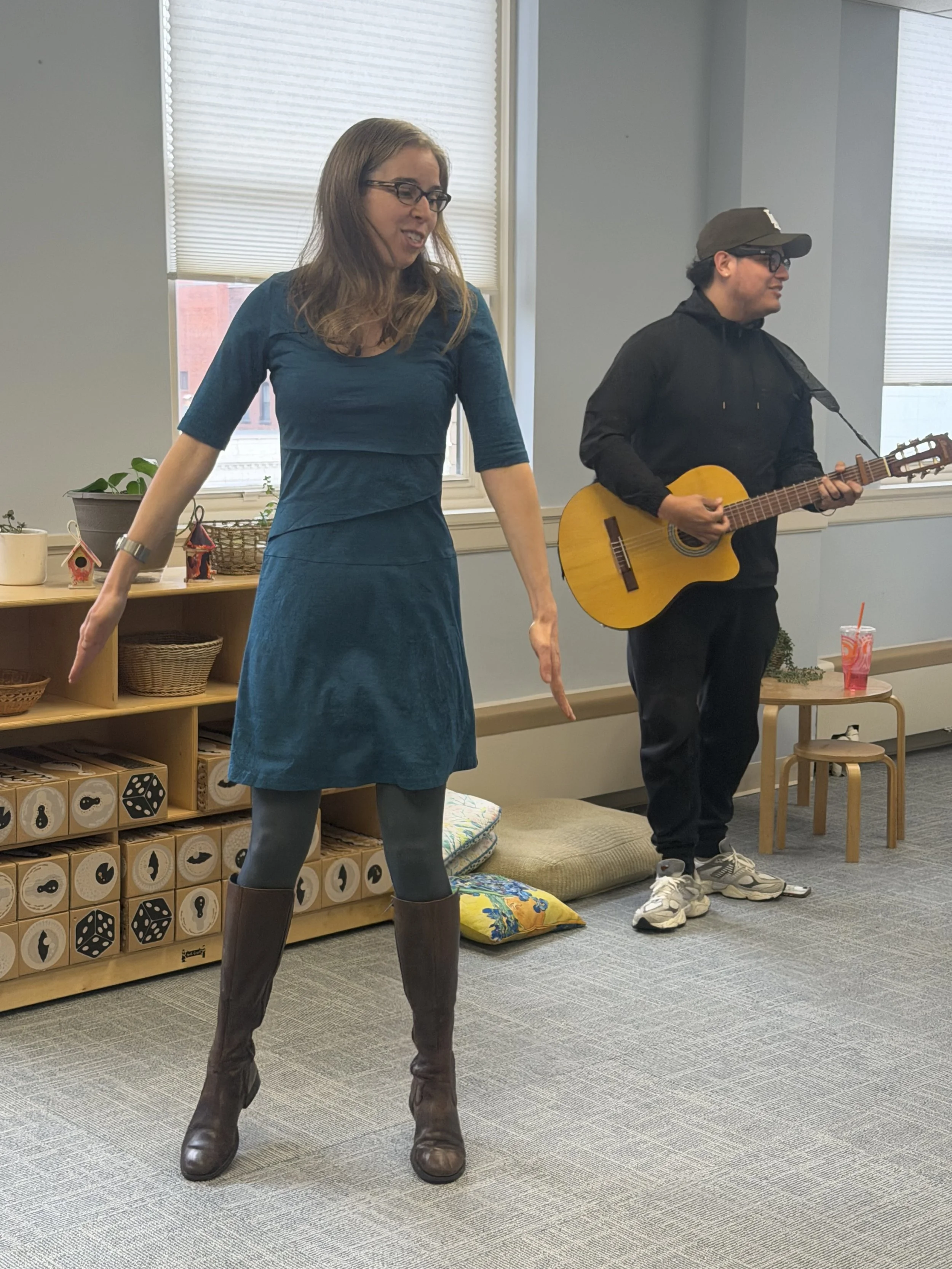
The work in action
Jon and Jess demonstrate “I am a penguin; you soy pingüino.” Jon accompanies on guitar while Jess hops like a penguin.
Jon’s first language is Spanish and mine is English. We both speak both, although he is fully fluent in English and my Spanish is more limited. When it comes to authenticity in our original bilingual songs, we default to using language as it is spoken in our community. To be more specific, Jon brings Puerto Rican Spanish to our songwriting, while the version of Spanish I started learning in school thirty years ago and continue to practice on Duolingo is European. I have yet to encounter a student in our city who immigrated from Spain, so we privilege the Caribbean-origin Spanish of the local community in our lyrics.
The city where we teach is believed to have about seventy different first languages represented among the student population. We routinely ask for information on the cultural backgrounds of our students. We automatically include Spanish with great frequency, but whenever we learn of another culture and language represented in our classrooms, we use a variety of resources to seek out music and activities from that group. All of our students deserve to see themselves reflected in our curricular content.
One final thought about using world language songs in singable activities: it may seem like the inclusion of world language lyrics adds unnecessary complexity and could be a barrier (or at least friction) to learning for students with higher support needs. However, that perception disregards the deep benefits and centers an adult mindset. Younger minds are able to acquire new language more easily than grownups for a variety of reasons. All children need and deserve musical richness and complexity, which makes the inclusion of world language songs imperative.