
Neurodivergence Affirmation and some barriers to implementation
Click here to read this post read in Jess’ voice.
Ableism is discrimination or prejudice against people based on their abilities or inabilities, whether real or perceived. Ableism can be deeply internalized within an individual and it can be built into everything systemic from policy to architecture.
One way to view disability is not as a deficit or brokenness in an individual, but a mismatch between their abilities and their surrounding environment. The latter is called the social model of disability. Everyone is capable of viewing disability through the social model, whether they know it or not. As an example, eyeglasses are an extremely normalized accommodation that helps an individual’s vision ability to match their environment. I am able to see very well when wearing my glasses, so I have full visual abilities. My inability to see without glasses is not a limitation that most people perceive, in spite of the signal that I literally wear on my face.
When a wheelchair user can’t get into a building, you could view the problem through the medical model of disability which says the problem is the person’s inability to walk. The social model of disability would say instead that the problem is that the building lacks a ramp or elevator.
In the social model of disability, there are problems with access and inclusion, but it doesn’t emphasize that anything is “wrong” with the disabled person. The deficiency is in the world around them, therefore it can usually be addressed.
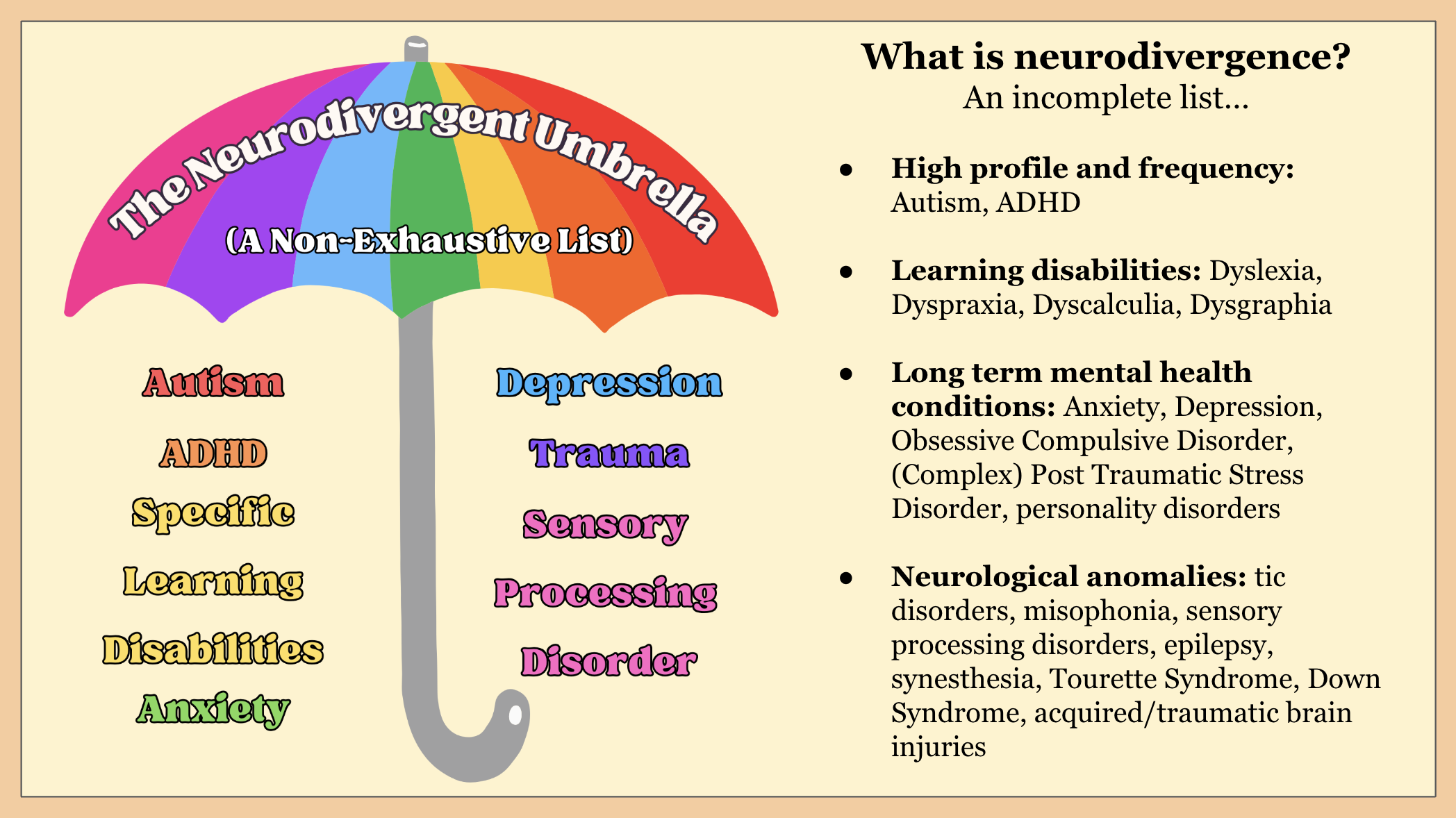
Neurodivergence affirmation (NDA for short, also known as neurodiversity affirmation or simply neuro-affirming) is an intentional and systematic approach to modifying environments and expectations to meet the needs of people who are otherwise disabled by the existing structures around them. NDA is a specialized form of anti-ableism that focuses on the needs of neurodivergent people, including those with autism, ADHD, anxiety, PTSD and more.
What does neurodivergence affirmation look like in practice? We appreciate the principles as described by Sonny Jane Wise, also known as the Lived Experience Educator. Acknowledge intersectionality. Presume competence. Respect autonomy. Validate differences. Reject neuronormativity. Reframe expectations. Promote self-advocacy. Prioritize lived experience. Nurture positive self-identity. Adapt systems & environments. Honor all forms of communication. We strongly encourage you to read Sonny’s explanation of these NDA pillars.
What does NDA look like in the music classroom? Honestly, it looks a whole lot like Universal Design for Learning. Differences are the expectation and are honored and celebrated. There are lots of ways for students to engage with the musical material and be successful. Compliance is never the goal. Students are allowed to stim and move freely and without shame. Students feel safe and ready to learn, and they have all the tools that they need to learn. They consistently feel that they belong in their classroom community.
Does that mean that students are allowed to do whatever they want, whenever they want? Of course not. The focus is on learning, with the understanding that learning only happens when students are regulated and ready, so self regulation and readiness are actively supported. This philosophy is sometimes wrapped into an SEL (social-emotional learning) framework in schools when it is applied to all students and not just neurodivergent learners.
NDA can take more effort and preparation than teacher-centered, compliance-based classrooms do. Your space needs to be prepared to accommodate all the physical and movement needs of all your students at once. It needs to be prepared to meet all the sensory needs of your students. You may need to prepare more instructional materials like visuals supports or choice boards. You may need to make time and materials for assessing neurodivergent students differently than their typically-developing peers (like a pitch sensitivity assessment for non-speaking children who don’t sing). You may need to completely replace past classroom activities that can’t be adapted to meaningfully include all of your students who have different needs.
Time is a finite resource for every teacher. Building all of these systems into your classroom takes training and time, not measured in hours but in months and years. The good news is that it is all cumulative. The more that you do it, the bigger your library and toolkit, and the easier it gets. Sometimes (but not always!) just the effort and awareness that you invest in the early days helps students feel like they belong just because you see them and acknowledge that they still have unmet needs. These students often knowingly or subconsciously expect to be shamed and treated as though they are burdensome, so taking every opportunity to show and tell them that they are wanted just as they are is never a wasted effort.
NDA practices are in many ways a radical departure from the European education conventions that still dominate modern American public education. Administrators may have non-affirming expectations of student behavior, up to and including suspension of students for openly expressing the unmet needs of their neurotype. Schools may lack funding to provide equipment like appropriate lighting, seating or even classrooms with sufficient space. Sometimes parents of neurodivergent students (who are likely neurodivergent themselves and carry a lifetime of related trauma) object to neuro-affirming practices being used with their child. Teacher mentors and colleagues may advise you to use non-neuroaffirming methods like clip charts and Whole Body Listening. They may make you feel judged and incompetent for “permitting” difference and not enforcing compliance. Especially in the early years of teaching, you might fear for job security if you use approaches that are not favored in your school community. Implementing neurodivergence-affirming practices in your classroom can feel in many ways like swimming upstream, but that doesn’t mean it’s not worth the effort. It makes a difference to every student it touches, including the neurotypical ones who learn from our modeling of acceptance and affirmation.
One important thing that we can do in difficult situations is to seek out community and validation from like-minded educators. That is one of Medley’s purposes– to bring educators together, especially through professional development and online community-building. We know that what we are doing is justified by both morality and research, even if it is not fully accepted by every member of our school community. We can help hold each other up and pull each other through when things are hard. In more concrete services, we can help each other troubleshoot: how do I solve this issue with this student in ways that align with my beliefs about their personhood and the needs of their peers and my own needs and access to resources? This is the reason that Jen and I offer FREE online office hours. Please come join us so we can support one another and honor our students and ourselves.