
Social Stories for Musical Inclusion
This blog post was co-authored by Jess with Medley’s colleague, Speech and Language Pathologist Lauren Nicosia.
Click here to hear this blog post read in Jess’ voice.
Social stories or social narratives are a tool to help students (and adults!) prepare for new experiences. They tell children what to expect, which removes the fatigue of uncertainty, prepares the nervous system, and reduces the emotional and cognitive load of entering the new experience. In short, they make it easier to try new things and successfully navigate something that is otherwise unfamiliar.
Educator Carol Gray is known for creating this strategy, and trademarked the term Social Story in order to maintain standards in the form of ten specific criteria. The use of this general strategy without strictly adhering to the criteria can also be called social narratives.
Social narratives may be presented to students as a physical book or booklet, cards on a ring, digital slides, or a video. Repeated exposure to the story is an important piece of the effective use of a social narrative for the child.
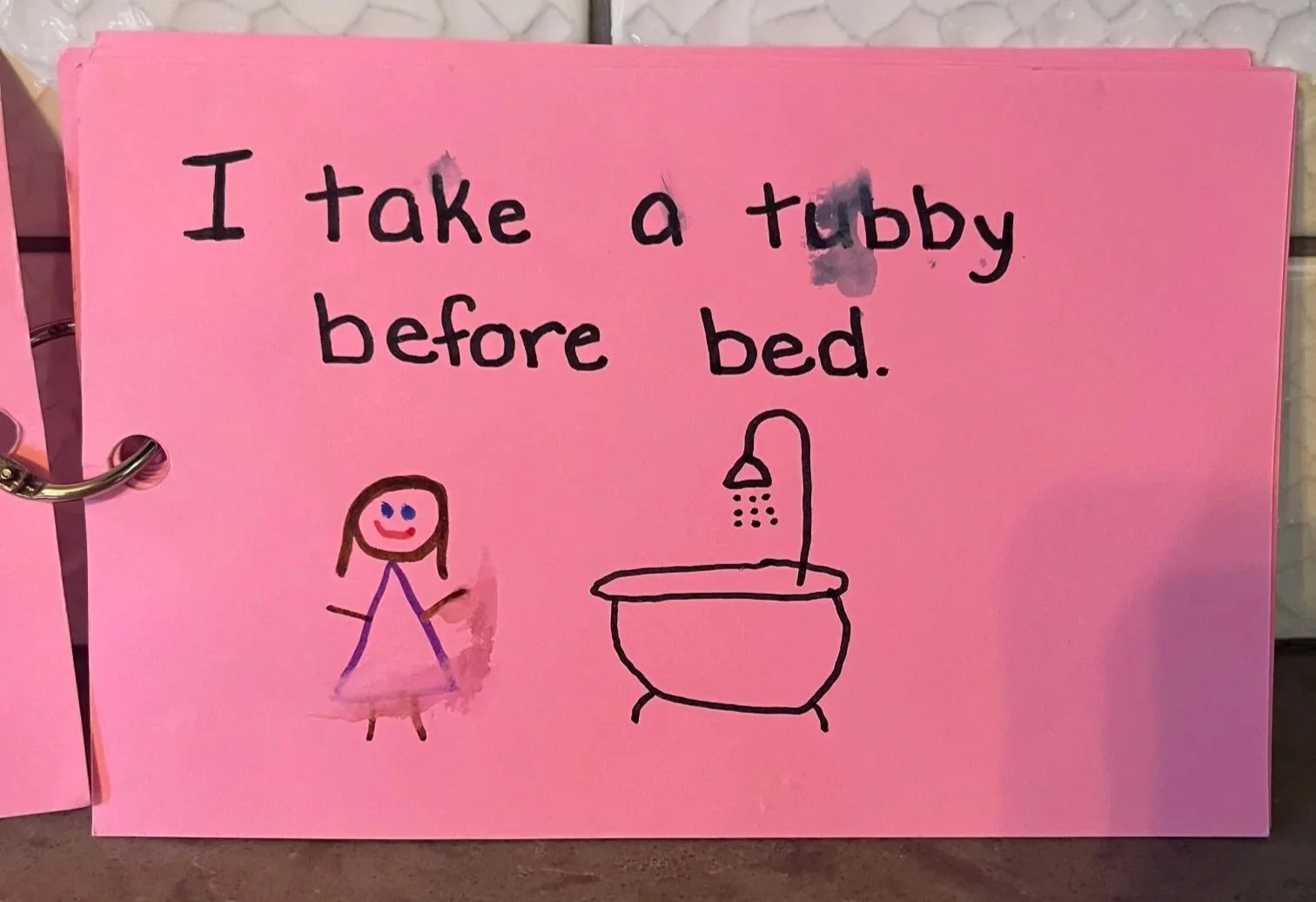
Lauren provided an example of a social story about taking a bath.
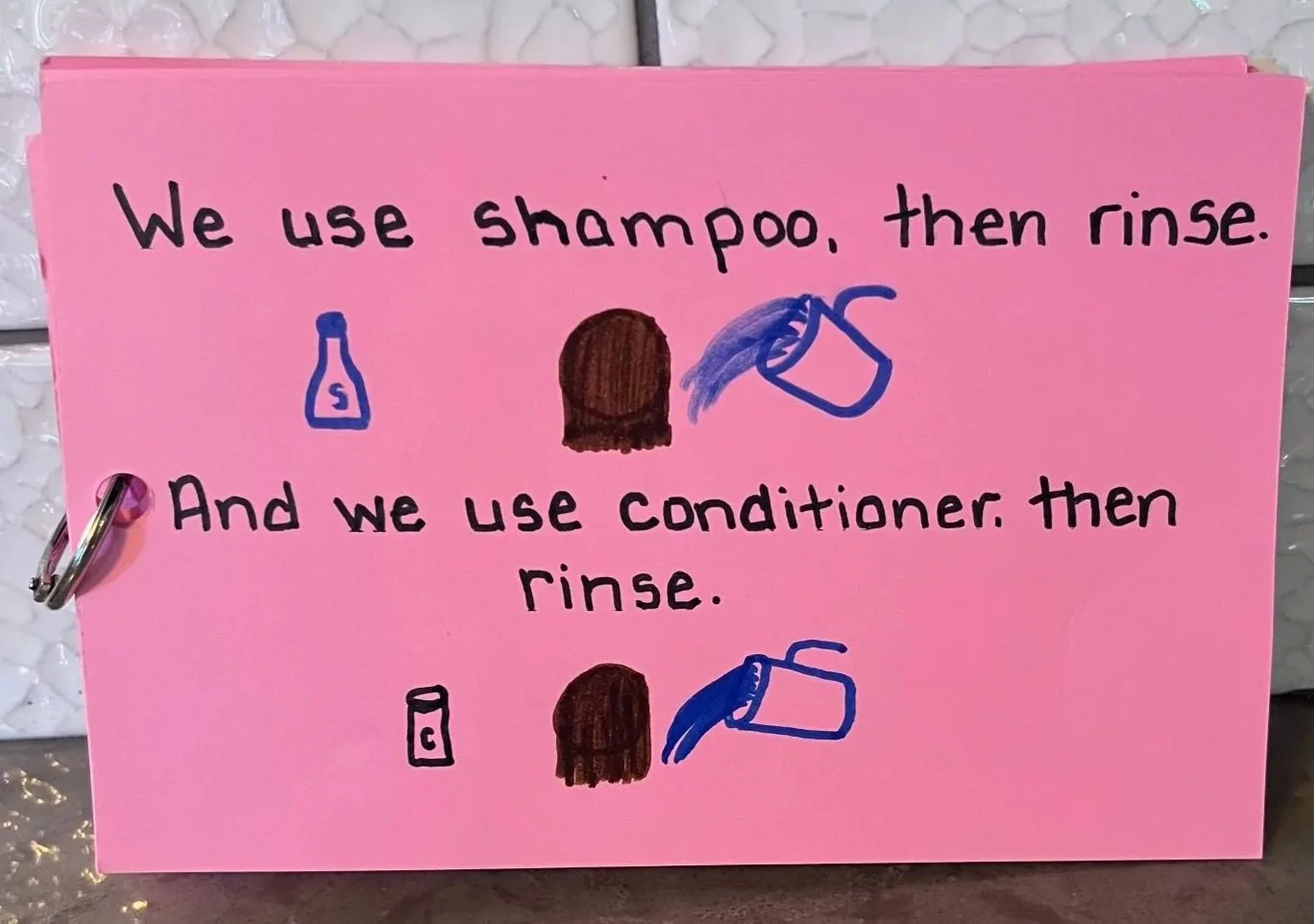
This social story is handwritten with line drawings on cardstock paper, which has been cut into cards, holepunched, and placed on a key ring.
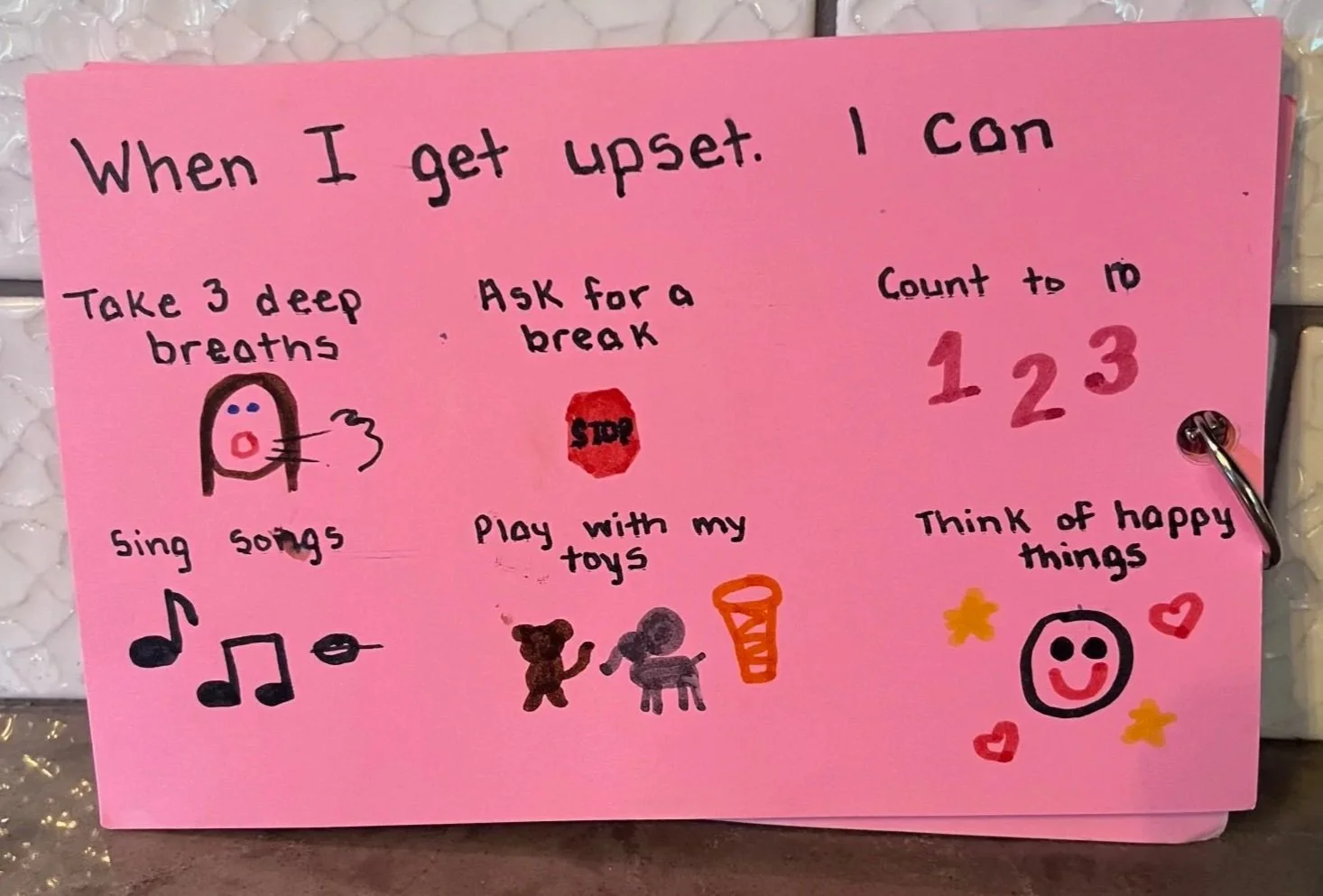
The social story describes steps of the bath (not all are shown here), and also choices that the child has for managing their feelings about bathtime.
Here is an example of social narrative text about an elementary school concert. Note that this narrative expects that the student will perform; if you are creating a narrative for a student with a PDA profile, consider using optional language like “I can stand on the risers with my classmates.” This social narrative isn’t truly complete until it includes supporting visuals, likely photos of the actual setting (the room, the stage, the teacher, etc.) of the school’s concert.
My school concert is Wednesday, October 28th.*
When it's our time to sing, I will stand on the risers with my classmates. We will sing What a Wonderful World. Mrs. Gray will play the guitar.
The audience will watch and listen, then smile and clap.
After our turn, I will sit and watch other students perform.*
When the concert is over, I will go back to my classroom, get my backpack, and go home.
If the lights are bright, I can shade my eyes. If the concert is loud, I can cover my ears. I can ask for a break.
I go to my concert. I sing for people watching. I have a calm day.
*The asterisks in this sample story represent places where you might be tempted to add more words, but using images is a better option for students with communication differences. At the first asterisk, a picture or video of the concert setting will show the stage set with risers, the gym or cafeteria set with audience chairs, and visually give other explanations of what to expect. At the second asterisk, we would show what tools will be available while watching the concert, like sensory tools and a floor chair.
Here are some other helpful tips from Lauren for writing a social narrative:
Keep it entirely objective: the facts of what will happen, observable behaviors that are unarguable. Be honest.
Keep it brief in overall length, and use as few words as possible to convey the message. Use accompanying images to reduce the need for extra words.
Make it as personally accurate as possible. For instance, instead of saying "the teacher," use their actual name.
Similarly, if you are going to include visuals in the story, try to make them accurate. Line drawings work, but photos of the actual location, teacher, etc. are best.
If you want to have feelings mentioned, they should be a means to plan ahead and problem solve. For example, after presenting a maximum of four to five steps describing the run-down of events, you can include "concerts are loud. Sometimes it does not feel good to hear loud noises. When I get upset, I can... [choices and supports]"
Provide a positive, clear summary statement at the end. I like to add those at the end almost as positive affirmations if we're expecting some difficulty.
Involve the child in writing the social story as much as possible! They might be able to choose the wording and identify their choices and supports. If not, they can choose the color of the paper and help fasten it together or decorate the front cover. Ownership in the project should help the student take ownership of the experience itself when it comes.
Read the narrative along with the student consistently and repetitively in the days leading up to the event. Depending on the child, two times a day for the five days leading up to the event might be an appropriate amount. If they inquire or request to read the story, do so. If they don't like reading it or having it read to them, have a teacher or aide read it aloud to themselves while the student is within earshot. Just like in early childhood music, even no response is the right response.
While not typically packaged like a child’s social story, adults also rely on this type of preparation! Any time you feel incremental internal relaxation or reassurance from receiving the schedule and details of a district PD day (are they providing lunch this time?), or looking up the Google Street View of a new destination, or confirming the correct pronunciation of a name that you’ve only seen in print of someone you’re about to meet, you are doing your own nervous system the same favor. It makes you more relaxed and confident in new situations. Using social narratives can be a game changer and outcome changer for children of all profiles. Tell us in the comments– what sorts of situations have you used for social stories for children or yourself?
Lauren Nicosia is a licensed and certified Speech-Language Pathologist who specializes in early intervention, supporting kids in developing their communication skills to interact effectively in home, school and social settings. A musician herself, she incorporates music in community classes that she leads in Pittsburgh as Family Jam.