
The value of simple, live classroom accompaniment
I am not a very good guitarist. Or pianist. I have only functional frets skills: I know a good number of chords, bar chords are hard for me to play clearly, I’m a lefty who struggles to hold a guitar pick in my right hand, I’m more comfortable on nylon strings than steel, and I really only use one strum pattern in common time. My music therapist friend Nora calls this pattern “strummy strum.” (1 2+ +4+)
I accompany my classes all the time anyway. When we post activity demo videos with accompaniment, they will almost always be played by Jon or Jen, who are really guitarists, but occasionally you’ll see me do it too. The thing is, my students don’t care that I can’t include melody on the strings or do cool articulations. I can see in the quality of their attention and engagement that just hearing the harmonic and simple rhythmic support that I can provide meaningfully enhances their experience. One example is that if I am leading the class in a walking-around-the-circle game, I notice that they are more likely to step with the pulse of the song when I play as well as sing, and they appear more attuned to the music than if they were hearing my voice alone. The accompaniment also helps with group cohesion if they sing without me.
One thing that I feel strongly about in elementary music education is that children deserve a rich and varied diet of musical complexity. Children’s music is great– I love children’s music and write it myself– but I would never deliver an entire lesson of just singing kids’ songs a cappella. Game activities like that are essential to a general music class and early musical development, but if it’s the only thing we do then we’re being negligent in our duties to our students. We need to provide them with a variety of high quality musical models so that they understand the diversity of artful music that exists in the world, and so that we can find the types of music and musical elements that will most engage them as individuals. Over their time with us, they should hear a broad assortment of instruments, ensembles, languages, tempi, character, aesthetics and mood, and observe that all of it is equally valued.
Using an accompaniment instrument, even at just a basic performance level, can do a lot to add musical complexity to a lesson. Live accompaniment adds the timing flexibility and social component that are missed by using recordings for this purpose (though, of course, a recorded ensemble can add even more musical intricacy). It shows students that playing an instrument is something that everyday people do, and maybe they can, too. But most importantly, especially for our student population with high support needs, it provides a pleasant and engaging sensory experience. It’s an extra access point to musical engagement. It simply makes our song games more interesting to listen to. You can see it in how they respond to instruction with and without it.
I accompany my classroom activities on ukulele. It’s not a typical ukulele, which would be a soprano ukulele; I use a tenor size ukulele. Typically a tenor would have the same strings and voicing as a soprano or concert size, but I have swapped out the nylon G string for a steel-wound G string that sounds an octave lower. Between the larger size and the lower octave of a single string, this ukulele has a warmer, richer tone and projects better than a soprano ukulele.
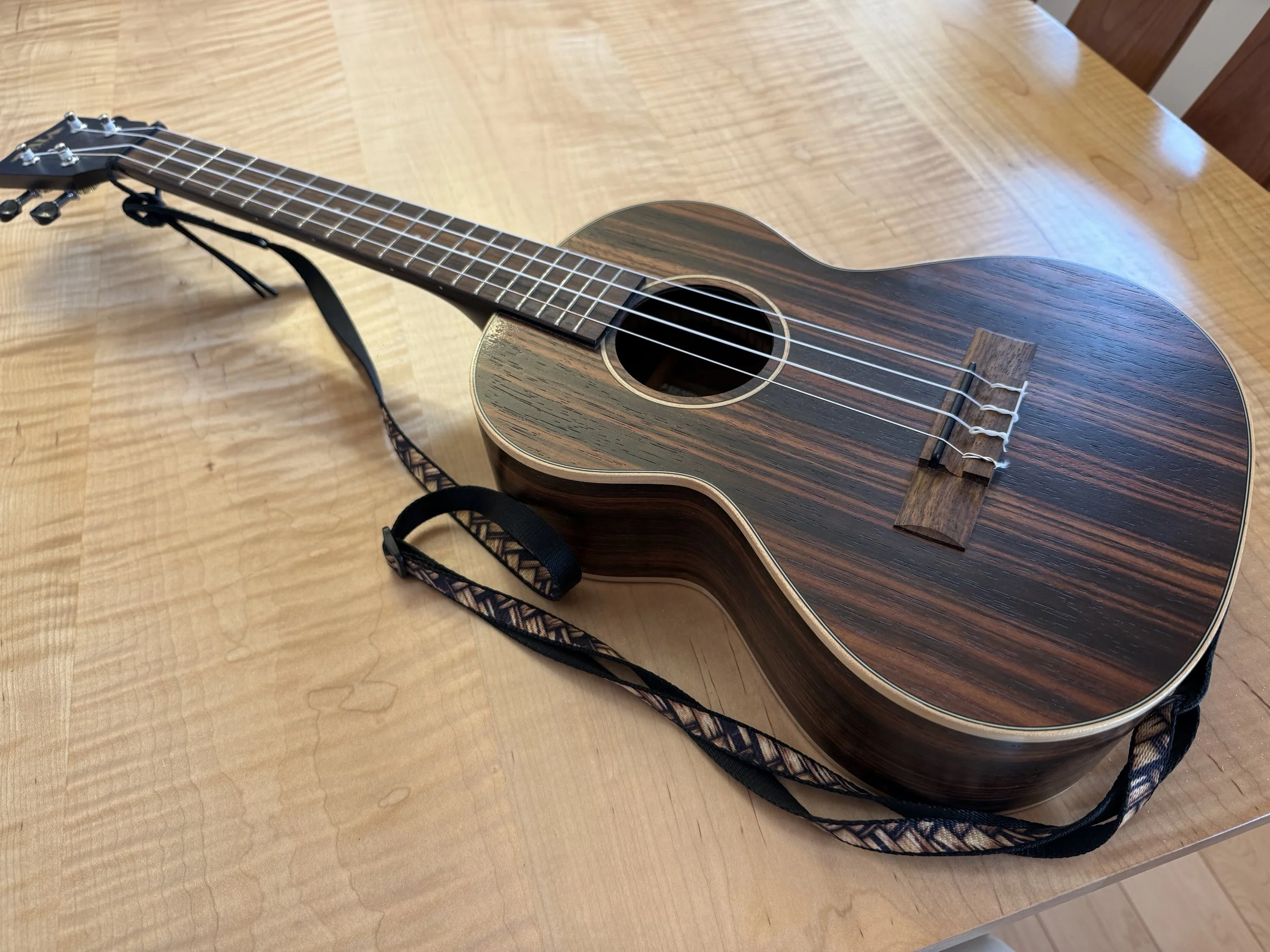
Jess’ ukulele.
The primary reason that I use a ukulele rather than a guitar is somewhat comical: I am clumsy and I frequently knock my guitar into doorways when I’m traveling within a school building. The ukulele fits compactly on my back and has yet to bash into anything while in transit. I’ve been using it as my daily instrument in itinerant music teaching for five years.
One other way that I bring musically complex sounds into almost every class is with a standard weekly recorded music activity that I refer to in my lesson plans as simply “Steady Beat”. Following some ideas that I learned in my First Steps in Music training, we have curated a list of recordings in the 120-138 beats per minute range, because that is the tempo range where younger (and, theoretically, most developmentally delayed) students will be successful in performing a steady beat. The list includes a wide variety of non-Euro-centric/descended genres and performers including jazz, big band, Motown, West African drumming, KPop, Afrobeat, calypso, blues, reggae, spirituals, mariachi, salsa, Bollywood, disco and more.
In this weekly activity, I give the simple instruction “do what I do!” and start by tapping my head to the music. We then proceed through a varied sequence of repetitive movements that include tapping various body parts, isolating body parts for movement, stepping, making repetitive motions with arms and hands, etc. We change movements with the musical phrases, so we are reinforcing an internalized sense of musical form in addition to steady beat. Sometimes for variety we will do the same format of imitative activity with recorded music using movement scarves, finger puppets, claves/rhythm sticks, shaker eggs, movement ribbons, or a stretchy band. When the students’ interests and abilities will support it, they take turns choosing the repetitive movement for others to imitate.
This routine is a great gross motor movement break in the middle of class. The combination of activity familiarity with weekly musical and movement novelty helps students to feel safe and organically engaged. It works on steady beat, phrasing, joint attention, large motor movement, creativity, and gives a variety of sensory inputs. And, importantly for my philosophy and lesson planning habits, it ensures that I have a weekly dose of high musical complexity and diversity beyond my own performance abilities for my students’ benefit.