
The value of visual schedules
Click here to hear this blog post read in Jess’ voice.
When I first started working with sub-separate Special Education classes, I was skeptical about the value of using visual schedules. I am now a convert.
In my first year of adaptive music teaching, I had an autistic fifth grade student in a sub-separate classroom who was enthusiastic about music class. However, for the first two months, he would invariably get into a power struggle with one of the classroom paraprofessionals about ten minutes into class. (Side note: I wish the adult had made different choices! For reasons related to the school arrangement, I was not able to intervene.) These conflicts would understandably cause him to dysregulate, then the classroom staff would quietly remove him from the room. This pattern caused him to consistently miss the second half of class.
Although I had my (uninformed) doubts, after many weeks of this I decided to try providing a visual schedule to this student’s class. A visual schedule is basically a developmentally-appropriate lesson plan summary. Using pictures and/or text, it tells the students what activities to expect during the lesson and in what order. As you proceed through those activities, completed ones get crossed off. The static visual nature is important; a verbal overview of the upcoming lesson plan does not have the same power of ongoing reference as a written and/or graphic visual schedule.
Because I was an itinerant music teacher traveling between classrooms and school buildings, I decided the most efficient way to provide a visual schedule was using an easel-size Post-It paper. I wrote out my lesson plan outline in marker, rolled up the paper, self-adhered it into a tube, and carried it to the classroom. When I arrived, I unrolled it and easily stuck it to the board, and asked a student helper to take charge of crossing activities off as we finished each one.
To my great surprise, the struggling student very suddenly stopped dysregulating. The visual schedule, it turns out, was helping him to feel oriented in time and space. He could see what was coming up next. He could see what we had accomplished. If he needed a break, he could choose which activity to miss. The visual schedule gave him certainty. It took away ambiguity, and with it, anxiety. Because of this, he didn’t need to fight so hard with the paraprofessional to feel a sense of control.
For this student, the visual schedule was a game changer.
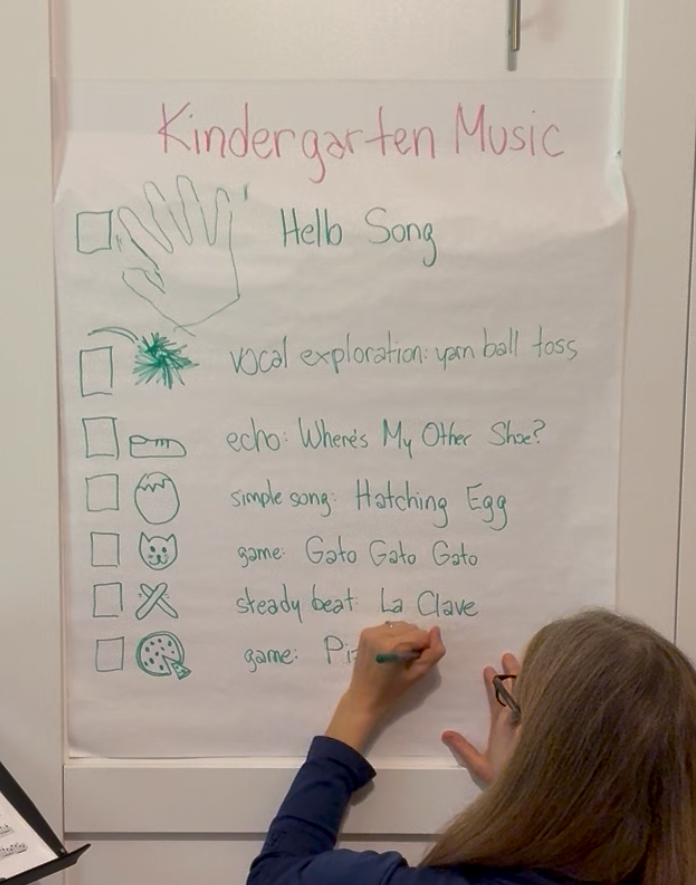
This sample visual schedule uses both text and hand-drawn icons.
A visual schedule must be clear but it does not need to be fancy!
While my circumstances called for my visual schedule to be printed on large paper, other possible formats include digital slides and marker on whiteboard. (If you have a lesson plan for multiple similar classes over the course of a week, consider using wet erase rather than dry erase for durability.)
Students who are pre-literate can still benefit from visual schedules that use images: a waving hand for a hello song, a frog for a frog song, a frozen stick figure for a movement activity, a maraca for a maraca activity, and so on. This is why all of Medley’s original activities include a digital icon.
If you post a visual schedule and for some reason you aren’t able to follow it completely– first, that’s normal! Second, it is very important to pause instruction, name the change and the reason, identify that you are asking everyone to be flexible, and check that they understand and are ready to proceed. Giving them an opportunity to express disappointment, adjust their expectations, and possibly even negotiate the change (“can we skip the frog song instead of the maraca activity?”) will help them to be resilient and remain regulated. If you are able, a helpful strategy for managing student expectation sensitivity would be to give them some voice and choice in the change, like having the class vote on which of the activities to end with in the revised plan.
A visual schedule won’t be a panacea for all dysregulation, but it is a low-effort approach that is always worth trying, and even trying repeatedly over time as students’ needs change. Let us know how it goes!