
The complications of tickling in the Adaptive Music classroom
Click here to hear this blog post read in Jess’ voice.
The children’s folk music canon includes many time-tested songs and rhymes that involve tickling a very young child, a group of compositions known simply as tickles. I first learned about them as an activity genre when I did my First Steps in Music training and we were focusing on infants and toddlers, but since then I have encountered them again and again. I used them with my own children when they were small, and have several that I treasure as intimate works of folk art.
Tickles are not typically used in an elementary school classroom for a number of reasons. The most important one is that schools are an environment with (appropriately) strict expectations for honoring bodily autonomy of people of all ages. Not only is tickling a sensation that is overwhelming or objectionable to some children so they might not want it, it involves intimate physical contact, often with an adult’s fingers poking or wiggling in a child’s armpit or belly. Because this type of contact could be part of a grooming regimen by an unsafe adolescent or adult, other people must be wary of accusations of misconduct.
Even with this in mind, there are certain student populations where we use tickles anyway– with extreme care. Tickles are most often used with babies and toddlers. Some of our elementary school students with complex medical and intellectual disabilities are in a similar cognitive and social developmental stage, and LOVE tickles as much as younger children do.
One particular current student comes to mind. When we first started teaching his class three years ago, he resisted all music class participation and physically pushed us away. He knocked me over on multiple occasions when I crouched next to him, and knocked my glasses off my face another time. One day, a few months into our first year with him, he finally consented to tickling and learned that he loved it. Now whenever a member of our adaptive music team gets within arm’s reach of his wheelchair, he grabs our hand and puts it on his knee to nonverbally request his favorite tickle. He is ten years old. Because he has learned to appreciate us and our tickles, he is now also willing to try other musical things. It turns out that he strongly prefers playing instruments with his feet even though he has use of his arms and hands. He will enthusiastically keep a steady beat on foot tambourine all day long, but his willingness to do this began thanks to his enjoyment of tickling.
This child is enthusiastically consenting to tickling, and even tickling himself!
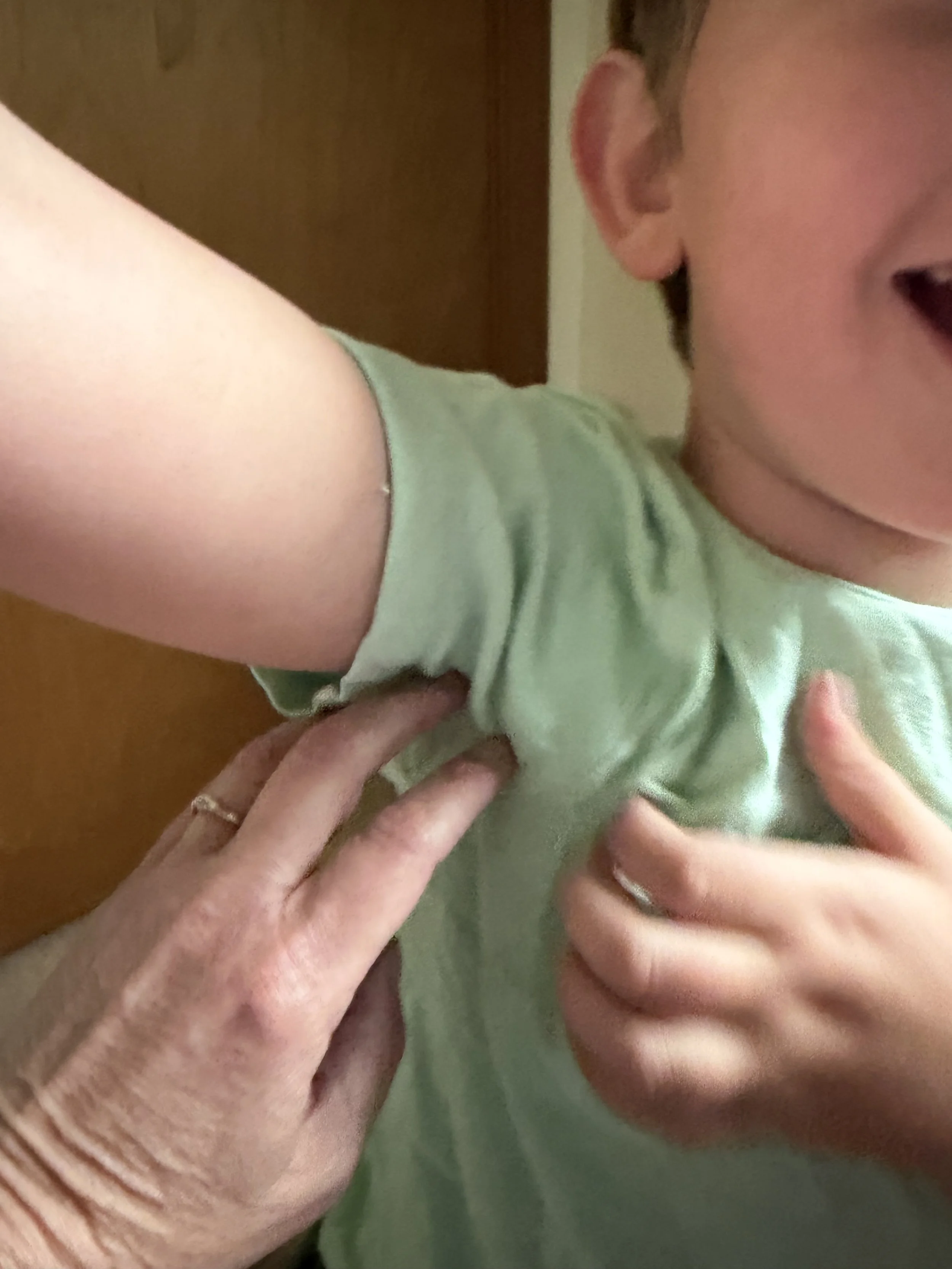
Appropriately tickling a person of any age requires vigilant monitoring for their full consent. We always start by verbally asking, “can I tickle you?” “Do you want to be tickled?” “Can I tickle your knee?” We ask even for students whom we know will not give a clear communication in the affirmative or negative. We can’t know for sure if they do or don’t understand the question. The non-response that we see might just be a communication difference, while they internally understand the question perfectly. So we continue to ask, then we watch closely to see if they flinch or pull away or lock down their elbows to protect their sensitive armpits. If there are any signs that they don’t want to be touched, we don’t do it. We might still give them a turn where we sing/chant toward them and make tickling gestures in the air several inches or feet away while making eye contact, which still gives them the intimate social interaction in the musical framework without the physical intrusion. Depending on their signals, we might not approach them at all, but we expect that they are listening as we do the tickles with their classmates.
Two years ago, a veteran teacher taking our graduate course pointed out that this type of physical contact with a student is more socially acceptable for female teachers than male teachers. I think that’s a fair point. We are aware that my presence in the co-teaching team with Jon helps to validate his tickling with this student population, not only because of my cis-female identity but also because of my authority as the program administrator. We do tickles side by side, each of us taking turns with every interested child, and coordinating our timing so we’re doing it in unison. One thing that I think is cool about this approach is that every willing child gets two different “characters” doing the same musical activity, so they get two different experiences.
There are certain circumstances where I would never tickle a child at school. I wouldn’t do it if we were alone and unsupervised. I also don’t tickle students who have obviously reached puberty.
So why do we do this, when it’s such a potentially fraught activity? One philosophical reason is to help remind kids about gentle, loving touch. Many of our students are touched repeatedly throughout the day by staff for medical and toileting reasons. From what we have seen, this type of contact is routinely done without any consent check, and sometimes over the active resistance of the children. We are showing the kids that they can also connect positively with others through physical contact, AND they are welcome to decline.
More importantly, we do tickles because so many children LOVE them. We save tickles for the end of the lesson because it really is the favorite thing for many of them. We have students with minimal motor control who will light up and belly laugh when we perform a tickle on them. Better still– if we perform most of a musical tickle but delay the punchline and tickle action, they will belly laugh in anticipation! For a student who doesn’t have the motor control to speak or sing or lift their arms or legs to hit a drum independently, this is a clear way that we can see that they are still deeply musically engaged.
Engagement can look many different ways. Musicianship can look many different ways. The obvious joy and delight that our students get from these developmentally-appropriate activities show us that they are, indeed, participating in the essential human experience of loving music with other people.