
Things To Know About Us
Click here to hear this post read in Jess’ voice.
We hope that if you are perusing our website and blog, you are considering taking a workshop or course with us! Of course, the formal website and brief bios don’t tell you everything that you might want to know. This blog post is a lowkey social story to let you know what to expect if you ever join us for a session.
First and foremost, we are unapologetically anti-ableist. Every single one of us exists in a societal context that deeply devalues disabled people and disabled lives. As a result, we all carry internalized ableism that must be actively identified, examined, and dismantled. This process can bring revolutionary ideas to light because we are collectively and individually accustomed to dehumanizing, dismissing and excluding individuals with disabilities. If you are not already immersed in the world of disability justice and you join us for professional development, you might encounter some ideas that are initially surprising or even uncomfortable. We hope that you will sit with these notions and arrive at a personal commitment to true access, inclusion and affirmation for your students and everyone else in your orbit.
We are not academics. We think it’s pretty cool that some colleges and universities have let us present graduate courses in adaptive music education, but we are culturally elementary school teachers, not professors. The minutiae of APA format does not spark joy for us. More than that, we are generally opposed to all forms of gatekeeping, which is a primary function of academia. We want to invite everyone in, not keep anyone out. You won’t see us getting hung up on how you cite sources for a research paper… but we will comply with institutional requirements in order to make our content available to teachers who need to earn graduate credit for their study and effort.
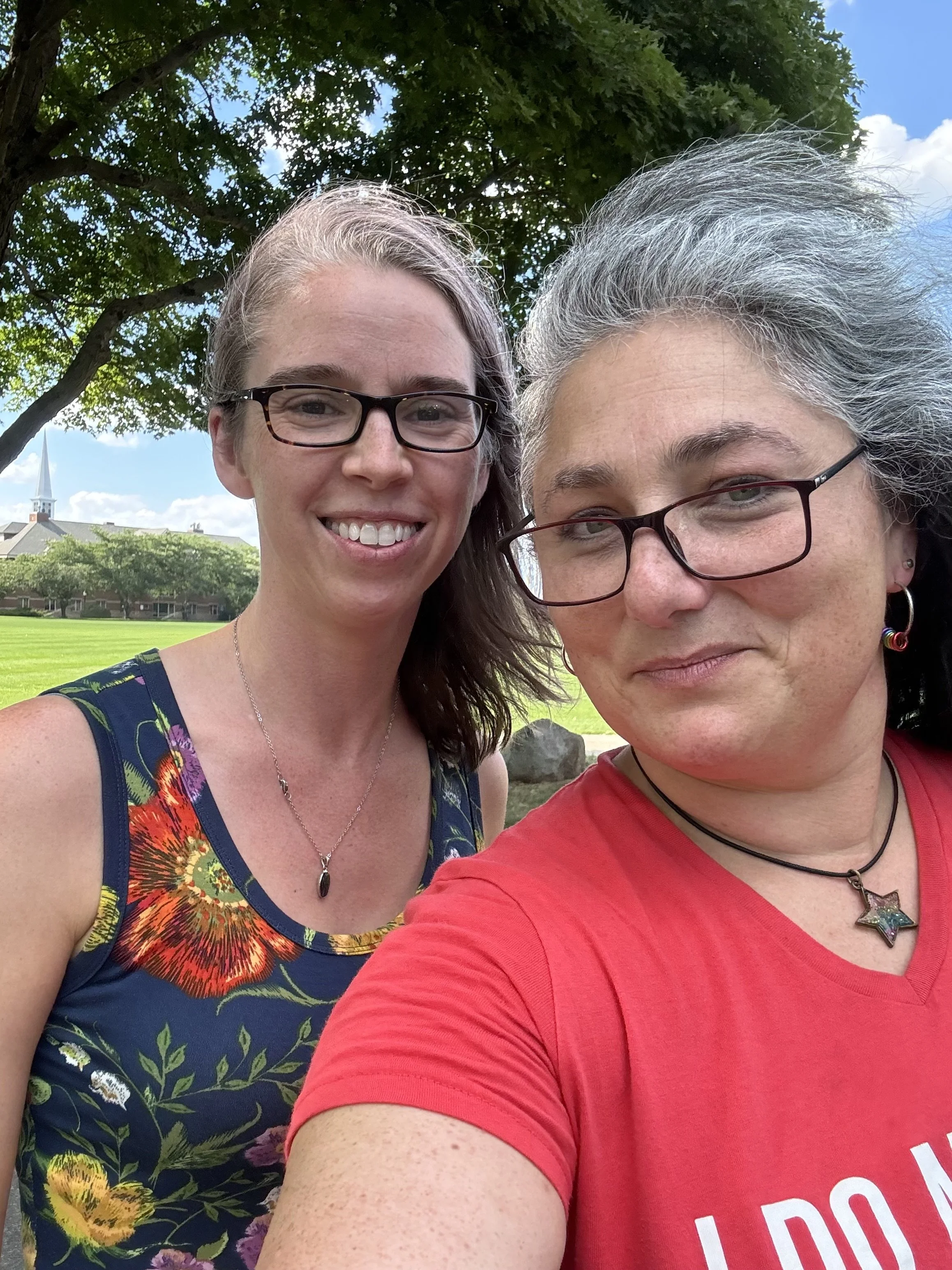
Jessica Corwin and Jen Kass take a selfie during a course taught at Gordon College.
We are intensely practical in the focus of our content. Yes, the theory and philosophy of anti-ableism is the foundation of all of our teaching and is woven throughout every presentation we give, both implicitly and explicitly, but we also make a point of connecting it directly to the music classroom in everything we do. How does this information impact your students? How can it change your language, pedagogy, planning, classroom environment and relationships? What does an effective activity or lesson for your students with high support needs look like? How will you know if you have been successful in reaching and supporting these children? All of our sessions include demo music class activities and the materials needed for our participants to replicate those activities in their own classrooms.
While we have taught music and/or provided music therapy to people of all ages from birth to older adults, we professionally specialize in elementary school students, generally ages 3-11. Most of our demo activities are tailored for this age group, but often they can be enjoyed by other ages as well (especially since one of our criteria for selecting demo activities is whether we enjoy them ourselves!).
We always center kids and their needs, but in practice one important way that this looks is supporting adults who support kids. We know that neurodivergent and disabled teachers exist, often while highly masking in the workplace, and they, too, require accommodation. Teachers benefit from the same types of accessible design as their students, so our organized course materials strive to provide as many points of access as possible: verbal communication, printed text (we always use supporting slide decks), social interaction, written records, photos, drawings, videos, audio recordings, signs and gesture, traditional musical notation, alternative musical notation, instruments, puppets, props, instructor demonstration, peer demonstration, product links and more. We want everyone to have as much access as possible to our knowledge and tools.
An important aim of our work is to foster human creativity, artistry, and expression. For this reason, we use little to no artificial intelligence in our work. We fairly compensate visual artists for creating the original images that we share. Occasionally I’ll use a thesaurus while composing a blog post, but the content is all human.
One final neat thing about learning with us is that you get two of us! Together we bring dual backgrounds in Music Therapy and Music Education, two divergent neurotypes, several varieties of first person disability experiences, and a friendship that models mutual ongoing disability support and accommodation. We hope you will join us soon. Click here to register for an online training, or click here to view our complete public events calendar including in-person workshops, conferences, and graduate courses. To book us to provide professional development for your school district or music education organization, email me at jc [at] music-access [dot] com.