
What are accessible and adaptive music education?
Click here to hear this blog post read by Jess.
Greetings from a snow day in my rural hometown! Let’s get right to some core questions and terminology: what is accessible music education? What is adaptive music education? Are these terms interchangeable?
(“How do I realistically do that in my classroom” is a much bigger question that can’t be answered in one blog post. If you are wondering about that, we hope that you will join us for some professional development at your earliest convenience!)
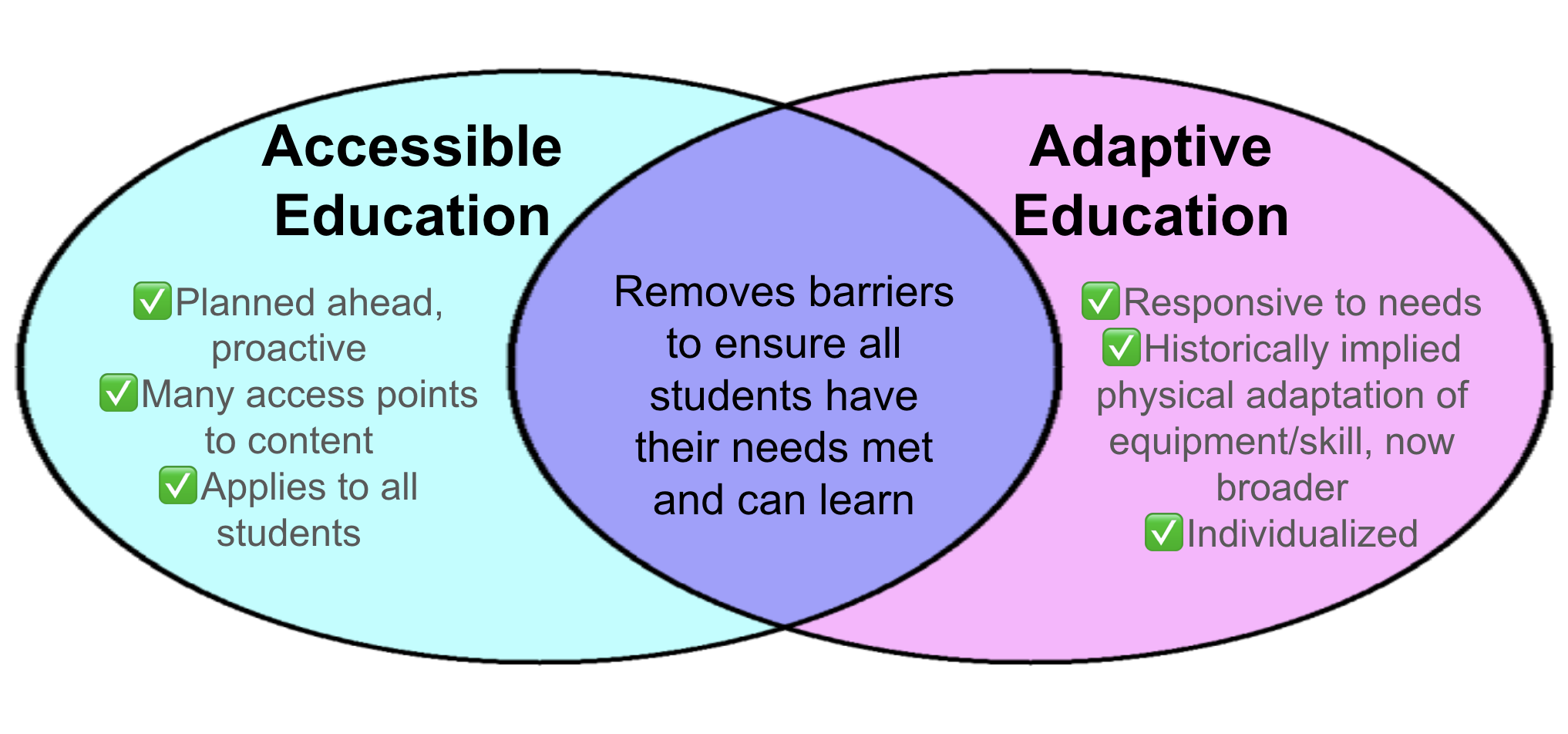
Accessible and adaptive music education are both terms that are about removing barriers to student learning so that every student can learn, but they are not the same.
American education has historically followed a fairly narrow, one-size-fits-all approach to teaching. We generally expect students to attend school for six to seven hours, starting early in the morning, five days a week, spending most of that time inside a classroom, probably sitting behind a desk or table most of the time, listening to and following group instructions from teachers, reading and writing on paper, using computers, taking tests, completing homework, etc. This model worked perfectly fine for me and arguably it does for a majority of people, but it doesn’t work for every kid, and it doesn’t make learning as easy as it could for most people.
Let’s imagine some theoretical changes and how they could ease the effort required for learning for some individuals: if school schedules allowed teenagers to sleep in and learn later in the day. If lessons could take place outside or in novel settings. If students could stand or move or talk while processing new ideas. If students could choose to focus on learning about topics that feel vibrant and relevant to them, rather than exclusively ones that were chosen for them by adults. If students could show what they have learned in ways that feel organic and meaningful to them rather than taking a test.
If you are internally protesting that some of these theoretical updates are ones that you already see in your educational community, then congratulations, you are already moving toward accessibility!
Accessible education is a framework that proactively removes barriers to learning for all students. It acknowledges that there is natural diversity among human brains, and learning is deeper and more joyful when it is not unnecessarily difficult. Accessible education provides multiple ways to interact with, understand and demonstrate learning of a single concept. It consistently incorporates elements of student choice. It modifies the learning environment for comfort, emotional safety, and readiness to learn. It values authentic relationships and identity affirmation.
This looks many different ways in a music classroom. In an accessible music classroom, students have multiple options for making their bodies feel comfortable, including with movement and sensory tools. Information and directions are presented in multiple formats like verbal communication, printed text, icons or illustrations, teacher modeling, peer modeling, and videos. Over the course of a lesson students have many ways to work on the same concept, like reinforcing steady beat through singing, gross motor movement, fine motor movement, and playing instruments at a variety of tempos and through a variety of genres of musics and musical formats (games, focused performance, improvisation, imitation, notation reading, etc.). The classroom runs on routines and clarity including visual schedules, creating a predictable environment that helps learners feel safe. Students see their family and community reflected in the musical content and classroom norms, and their strengths are celebrated so they know that they belong and are valued. Many forms of alternative music notation enhance student engagement. Student attention is engaged and sustained through humor, novelty, relevance, social connection and personal agency.
That sounds like just good teaching and a thriving learning community, right? That’s the idea.
One point of clarification: accessible education is designed from the outset for all students. It benefits typically developing children as well as disabled and neurodivergent learners. In contrast, adaptive education is a responsive and individualized removal of learning barriers for students with greater needs. Historically, this term was used to primarily refer to physical adaptations of skills and equipment, but now our understanding of individual student needs and respective adaptations are much broader. For example, in our daily work, we provide adaptations in communication tools and options (choice boards, choice cards, physical gesture, AAC collaboration), classroom environment (modified lighting, seating options, targeted sensory tools), norms and expectations (allowing for movement at all times, space from classmates, shoes off, student-directed exploration rather than teacher-directed, access to snacks, physical contact with teacher like lap sitting), very intentional hand-over-hand or hand-under-hand support for playing instruments, modified instruments, and more.
There are no limitations on what kinds of adaptations can be offered to students in order to facilitate their learning. We can supply endless suggestions to you, but adaptive music education demands teacher creativity. It is an opportunity to truly see your student and the barriers between them and meaningful music-making, and use every resource available to remove those barriers.
We advocate for the use of both accessible and adaptive education methods. In a nutshell, you start with accessible approaches that are available to all students, then on an as-needed basis you apply adaptive approaches for individual students.
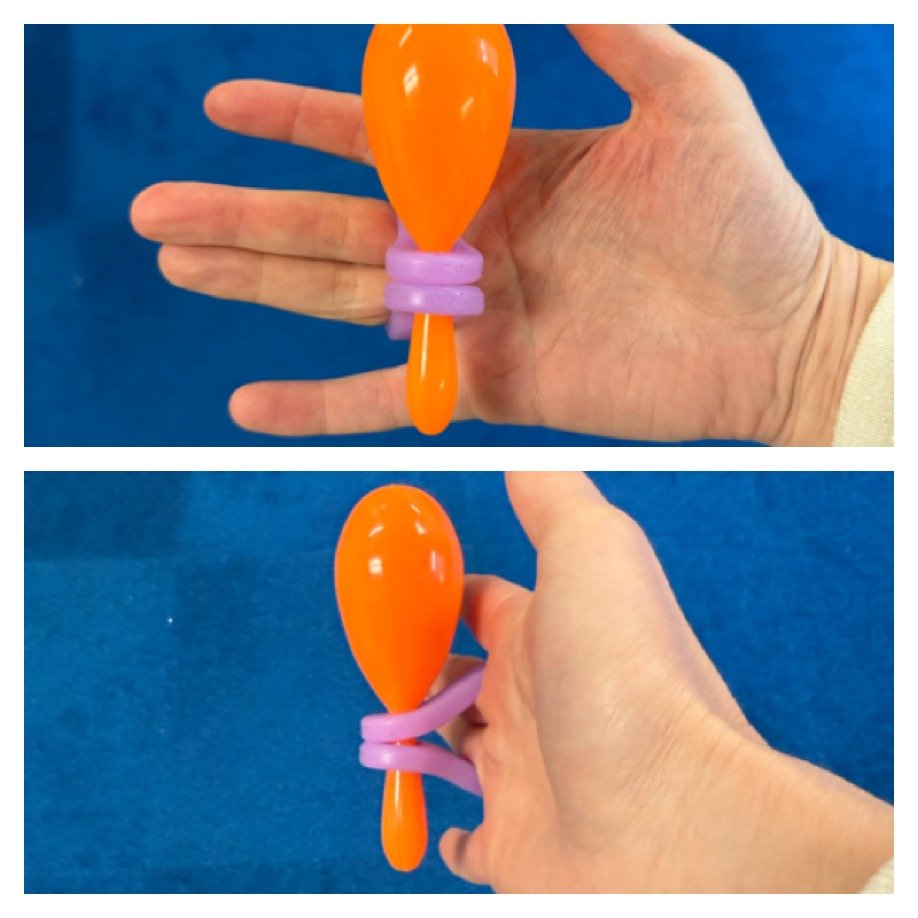
Assistive strap example
Two views of a small maraca-style shaker held in place on an open hand by a silicone strap. Straps can be made of a variety of materials.
Admittedly, when we, Jen and Jess, work with sub-separate Special Education classrooms where all students have high support needs, there can be some blurring between accessible and adaptive approaches. Some people might argue that the types of supports offered determine whether a specific action is ‘accessible’ or adaptive, but that’s not quite how we think of it. Here’s an example. They might say that a strap that supports a student’s grip on a shaker could only possibly be considered an adaptation because most students don’t need it in order to participate. To us, you can just offer straps to all students and that makes it ‘accessible’-- especially if students have a choice of whether or not to use the shaker with the strap or without it. We exclusively serve students with high support needs, so it makes sense for us to bring that level of support to all of our students, whether or not any given individual requires it for their learning and independence, and here’s why. One student might have minimal grip strength and require the strap for attaching the shaker to their limb. Another student might have the ability to grasp the shaker without the strap so it appeared that they didn’t need it, but the teacher is unaware that this is harder for them than expected, so having access to the support strap supports their learning anyway. Another student might see the strap being offered to another classmate and have such intense curiosity about it that their focus on the object becomes an internal barrier to engaging with the activity in an expected way. In this case, simply allowing that student to explore and use a shaker with a strap allows them to engage with the music activity. When we proactively offer options and opportunities to all students, we remove barriers that we didn’t realize existed for individuals, and we create a sense of belonging and purpose in learning.
But also, on the topic of whether shaker straps are ‘accessible’ or adaptive, we have to pose our own question: does it matter? We are not hung up on the semantics because we are laser-focused on children and classroom-level functionality. As long as all the kids are learning and engaging in the essential human experience of music, we are satisfied.
P.S. Did you notice our use of multiple access points in this blog post? Some people who want this content struggle with long form reading, so they can click the link at the top to listen to me read it. But it’s available not only for people who find reading difficult, it’s also there for people who want to listen while multitasking, who want the personal connection of hearing my voice, or have other reasons to benefit from an audio recording.