
An Essential Adaptive Music Tool: Choice boards
Click here to hear this blog post read in Jess’ voice.
Elementary music teachers know and use a simple trick to get children to internalize enjoyable music: coming up with a playful excuse to repeat a song in class. Often this means replacing a song lyric with a fresh idea for a new repetition (“what other animal did Old MacDonald have on the farm?”), or changing an accompanying action (movements with The Wheels on the Bus). When children pick the next variation, these activities are a great opportunity to incorporate student voice and demonstrate creativity, but sometimes our students with higher support needs get left out of sharing their ideas. The prompt might be too complex for immediate comprehension, coming up with new ideas might be beyond their abilities in the moment, or if they are minimally- or non-speaking, even if they have an original idea they may struggle to communicate it. Luckily, there is a simple and easily-created aid that can fully and meaningfully include these wonderful kids.
When I first started working with and learning from Jen, the first idea that she added to my toolkit was choice boards. Choice boards are topic- or activity-specific pictorial menus that students can use to stimulate ideas and communicate their choices for participation. Here is an example that I drew myself for activities where I ask students to pick what body part we should shake next (or stir the frog with, or stick the bubble gum to, or land the firefly on, etc.).
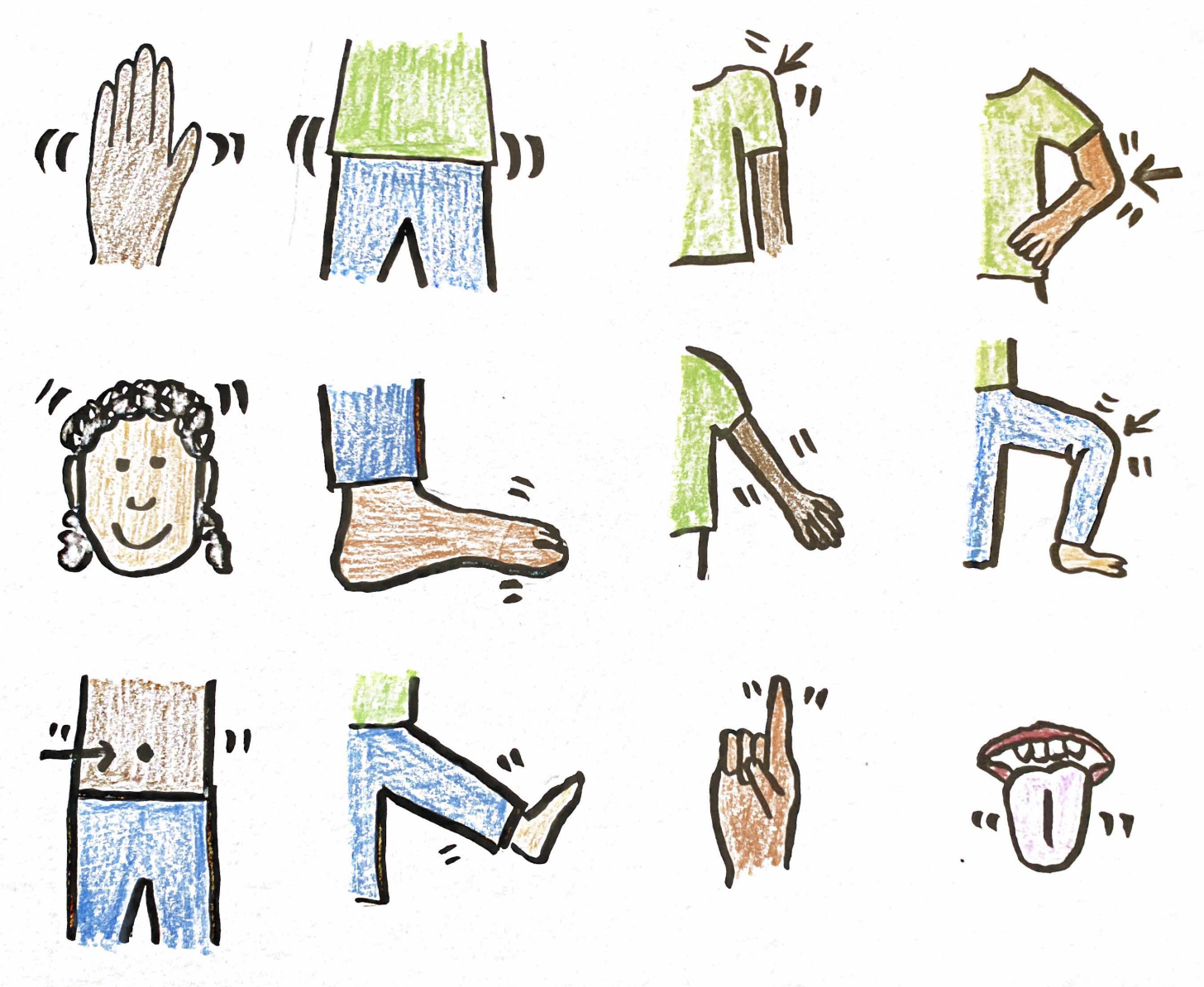
You would be surprised at how long it took me to draw this. There is a reason that this is the one and only choice board I drew by hand! For certain activities I cover the tongue option with a Post-It note or my hand.
In my own practice now, when I ask a student to choose a body part, I hold out my laminated choice board for their consideration. Most children will point to their choice. Some will look at the options and then speak their choice out loud. Some will get support from a staff member to point at an option on the board. Some don’t look at all and already know their answer. Very occasionally, a student will peer with a serious expression at the choice board and then nonverbally demonstrate their body part of choice.
If I was not using the choice board and asked my students to choose a body part, many would not be able to answer me. The steps of processing to answer my question “which body part do you want?” are far more demanding than you might expect. If I ask a child to pick a body part and I don’t supply the choice board, they need to consider: it’s my turn. I need to give an answer. I need to pick a body part. What is a body? What are its parts? Do I have body parts? Which one DO I want to shake? What will that look like? What will it feel like? How can I communicate my idea?
For many of my students, this is an overwhelming number of things to process at one time and they likely won’t be able to give me an answer, but if I simply hold out the visual menu, they get to skip many of those steps, communicate an idea effectively and efficiently, and be fully included like their typically-developing classmates. It also means that we quickly return to playing our music game based on their idea. It is simple, elegant, intuitive, and very, very inclusive.
My free PDF download A Song In Your Pocket, found on our Teacher Resources page, contains many ready-to-print choice boards to correspond to the activities in the book, including the body parts choice board shown above.
Creating your own choice board is a relatively simple process. Jen likes to use Canva for Education for this purpose. I often use a GoogleDoc and search the web for stock images. Usually I will search for the name of the image I need followed by the word cartoon: “fish cartoon”, “clock cartoon”, “moon cartoon”, etc. I look for simple and clear images on white backgrounds.
When building your own choice board, it’s important to keep a consistent art style between the images so that students are evaluating the content as much as possible and not the style, and stylistic choices don’t cause avoidable distraction. Extraneous details in the images can also be distracting, especially for some autistic children who can be very sensitive to visual stimuli.
Some children respond best to realistic photographs on their choice board. Whenever possible, I like to use local and familiar images that they might recognize. This could even include photos of people and places within the school building, depending on the activity and what sort of choices they are asked to make within it. If you need to create a choice board of actions, you could take original photos of yourself or another familiar community member acting out the options.
Because we are itinerant teachers, our choice boards are usually laminated paper. Sometimes Jen puts laminated individual choices onto velcro stickers, or magnets on a cookie sheet, which allows her to modify the choices on the fly. For some students, it is possible to put the choice board on a projector screen, although they need to have reasonably developed communication skills for that to work, so it might not be a good choice for children with higher support needs.
Learning to use a choice board is a skill that takes some practice for children. One scaffolding step for developing the skill is to use choice cards and present only two choices at a time. Please come back soon for our next blog post discussing the minutiae of choice cards!