
July 2026 Newsletter
Dear Medley friends and colleagues,
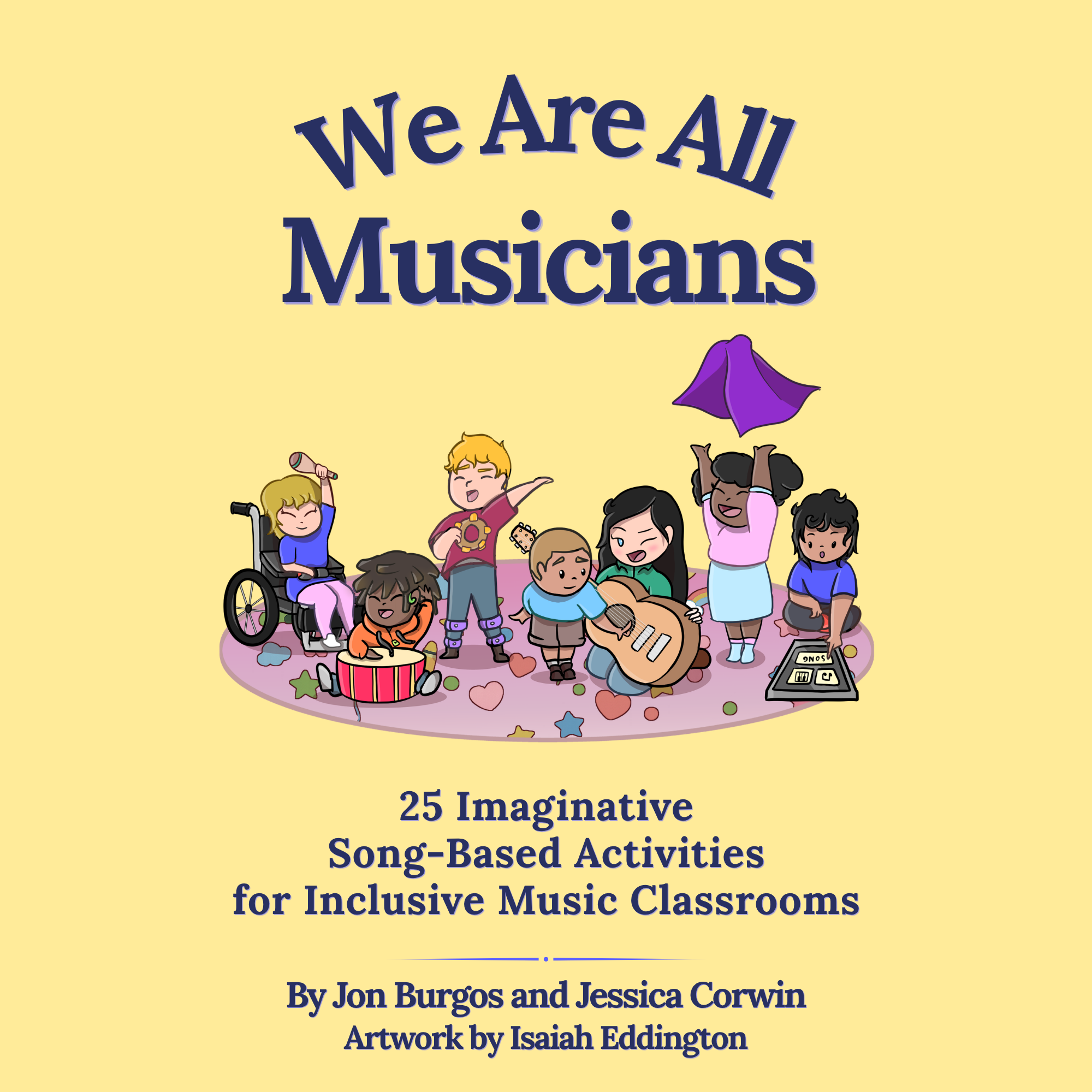
This monthly newsletter is a little later than usual because we want to honor our promise of no more than one email a month, but we also wanted to include our big news: our debut activity book, We Are All Musicians, is now available! Jon and Jess wrote 25 imaginative songs with accompanying activities for our adaptive music classrooms and Isaiah drew creative and whimsical artwork to further engage and empower students. We believe that it is the first-ever published classroom songbook to include choice boards, which are our favorite adaptive music tool. It is available immediately in digital form, and for pre-order in physical form (shipping expected by July 31st). Use promo code MEDLEYFRIEND for a discount on either format by July 31st. Both versions include online access to printable visuals, demo & discussion videos of activities, accompaniment mp3s and more.
In other fun news, last month we had our first viral video, racking up more than 600,000 views across platforms. Who knew that using a hair scrunchie to hold a drumstick would have such broad appeal?
Classroom activity videos and supporting materials below! Let’s start the information roundup.

In-person Learning Opportunities
July 27th-31st, 8:30 am-4:30 pm.
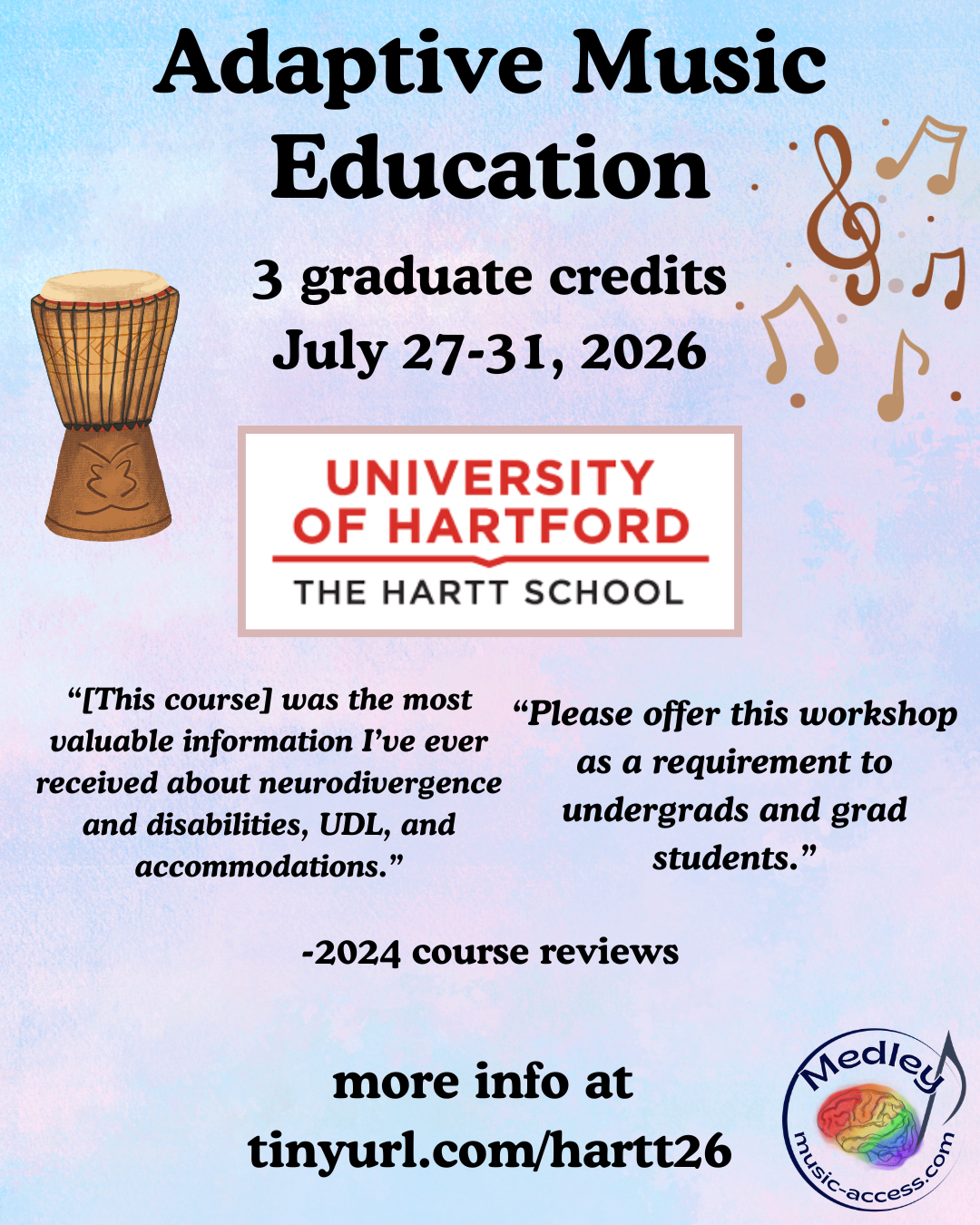
Graduate course: Adaptive Music Education
Hartt School of Music, University of Hartford, West Hartford, Connecticut, USA.
3 graduate credits. Tuition $775.
Course description is here, housing information is here, and registration is here.
August 13th, 9 am-3 pm
Intro to Adaptive Music Education
Natick, Massachusetts, USA.
6 PDPs/professional hours. Tuition $270.
November 3rd, 9 am-3 pm
Intro to Adaptive Music Education
Northampton, Massachusetts, USA
Registration info coming soon.
Online Learning Opportunities
July 20th, 21st & 22nd, 1-3 pm Eastern time (Boston/New York)
Online Intro to Adaptive Music Education.
Tuition $175. Register by June 5th to receive the discounted rate of $150.
September 21st & November 2nd, 4-5 pm Eastern time (Boston/New York)
Adaptive Music Independent Study. This independent study is for teachers who have completed Intro to Adaptive Music Education either in person or online.
Tuition $270.
One optional graduate credit from Worcester State University is available for an extra fee.
Summer Sun and Watermelon by Jon and Jess is a catchy replacement rhyme for the historically problematic Eenie Meenie Miney Moe. This song and activity are included in We Are All Musicians.
Five Little Kitty Cats is our adaptation of the traditional children’s countdown song Five Little Chickadees. We made up this activity to meet the interests and abilities of our students who love to throw things on the floor!
Fizzy Drink performed with real exploding seltzer, just for fun. This video can be shown to classes to help them understand the phenomenon of opening a fizzy drink that has just been shaken. This song and activity are included in We Are All Musicians.
‘Exhale’ performances are one way that we use receptive music to engage our students with live music. This video features Jon and Jess performing the fiddle tune The Spotted Dog Jig.
Use a hair scrunchie or elastic to facilitate independence for student musicians with low grasp strength.
The shekere is a preferred instrument for our students who always need physical assistance to play instruments because we don’t need to manipulate their bodies for them to be involved in performance.
Jen taught us that the ‘hang ten’ hand sign can be a very convenient communication tool for working with a non-speaking student.
Jess shared a story about practicing neurodivergence affirmation as a work supervisor using photos of her chickens.
The concept of spiky profiles is a simple but essential one for working with disabled students, explained in graphics and a video.
Visual supports are useful in general as adaptive music teaching tools, as we explained in a video, going into greater detail about the specific visual supports of visual schedules (video/graphics/blog) and choice boards (video).
We made DIY video tutorials for making your own yarn ball as a teaching prop (Jess’ favorite!) and adding grip support to a shaker egg.
Finally, Jess also offered disability perspective summer reading recommendations. These are compelling reads, not textbooks.
Thank you for your ongoing support! Please make sure to follow us on your favorite social media platforms and help us reach more teachers by interacting with our content. We are so grateful to be in this important work with you!
With gratitude,
Jess, Jen, Jon & Isaiah