
Click here to hear this post read in Jess’ voice.
I am writing this blog post fresh off a concert mini-tour of local libraries. Jon, our friend I-Shea, and I formed the Texture Tones Trio and gave three children’s concerts, two of which were publicized and presented as sensory-inclusive. It was a wonderful experience, so I want to share the practices that we used in order for others to consider how they can also host or produce sensory-friendly concerts.
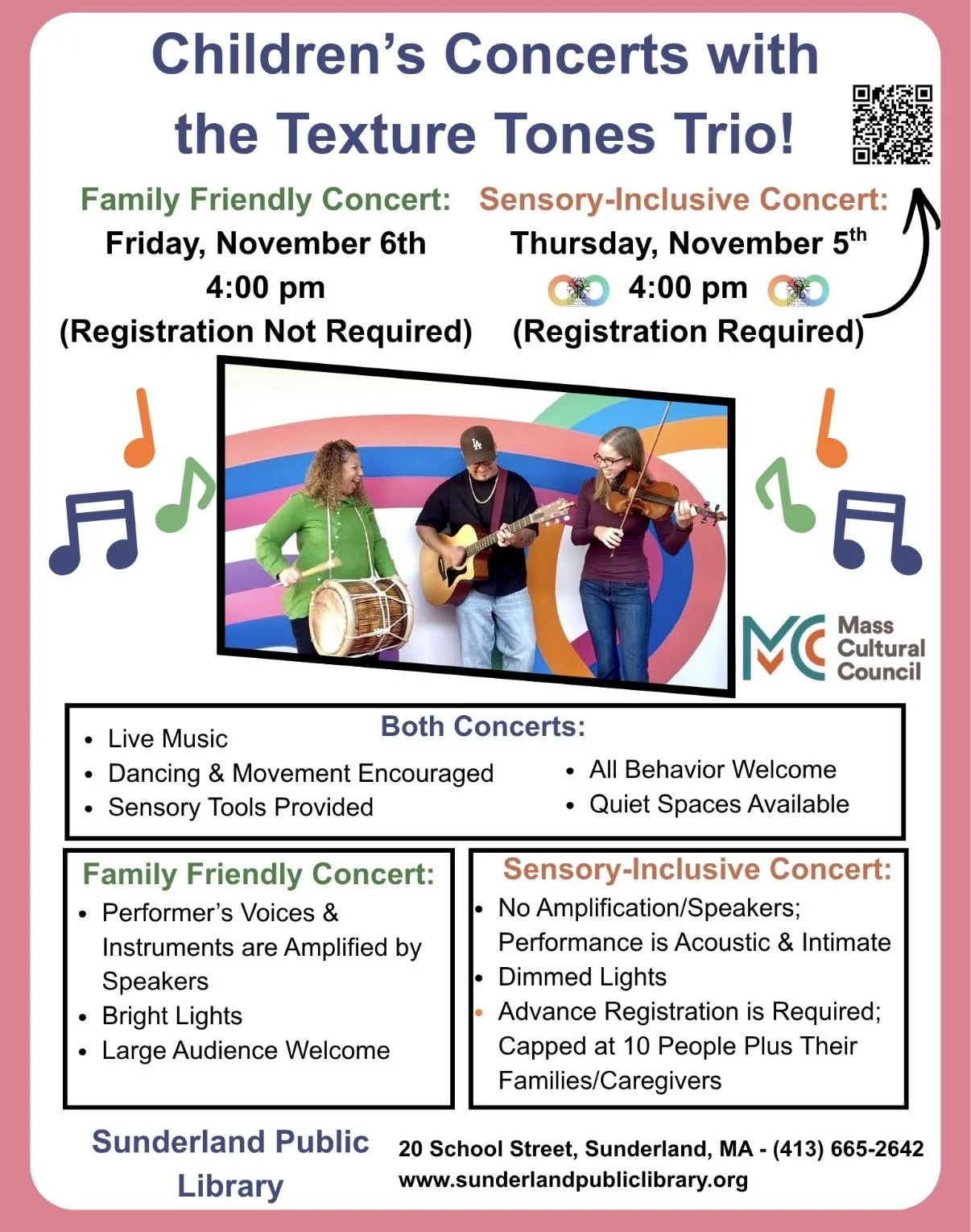
An event flyer for the Texture Tones Trio showing the differences between a sensory-inclusive and general family concert.
Sensory-inclusive events are those that are engineered around the needs of neurodivergent people who have sensory, attentional and social needs that may differ significantly from the general population. Typically they are open to all audience members, not just neurodivergent individuals and families.
One obvious and key element of a sensory-friendly performance is managing the sensory intensity of the environment. Our sensory concerts were performed without amplification, with dimmed lights, and we offered headphones as further mitigation if needed. If anyone needed it, a nearby quiet space was available for sensory recovery. Additionally, participants had constant access to other sensory tools including flexible seating, weighted lap pads, and a variety of fidgets.
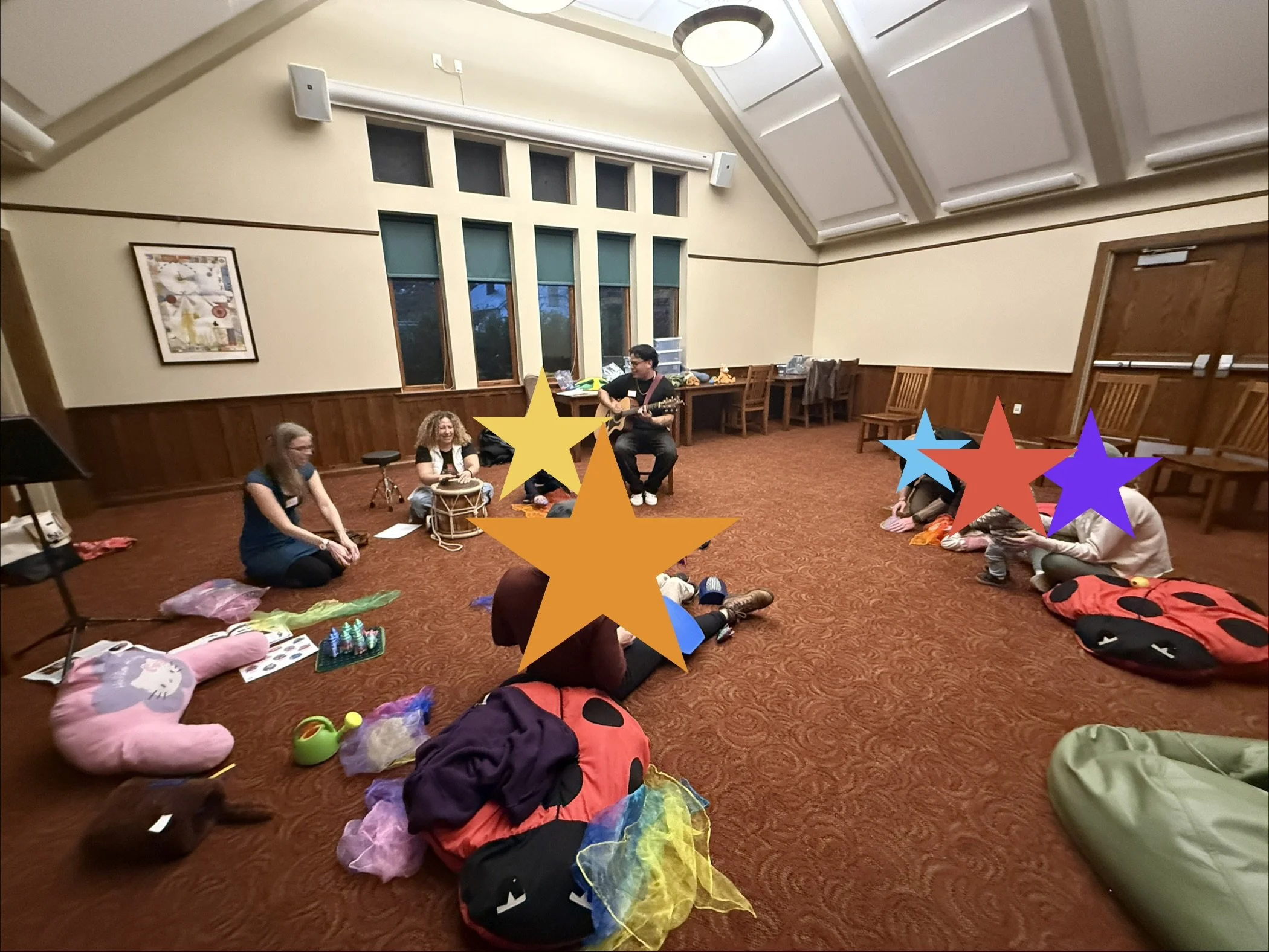
A sensory concert at Sunderland Public Library
Some audience members are visible in this photo but their faces have been covered by stars for privacy. The performers stood in a traditional concert style for part of the performance, and at other times sat down with participants. Flexible seating, sensory tools, communication tools, and musical engagement tools are visible.
Another important measure for containing the sensory environment is to keep attendance limited. Proximity to other people can be highly stimulating! For many neurodivergent people, crowds are intolerable, so highly-attended events are functionally inaccessible to them. To address this need, we requested advance RSVPs, capped at ten children plus their caregivers. This doesn’t actually mean that we expected to have all ten children attend– disabled families are more likely than the general population to experience unexpected challenges to their daily participation. It also doesn’t mean that we prevented walk-in participation when we had capacity– we certainly did!
I’ll note that the effect of these specialized performances with limited attendance is sometimes unfairly mischaracterized as “segregation.” I strenuously disagree with this framing. The purpose of segregation is to insulate a privileged group from experiencing any negative impacts from proximity to a disadvantaged group, and the effect is often that the disadvantaged group is provided with an inferior experience. This is the opposite of the purpose of a separate sensory-friendly performance. Our aim in creating these specialized performances is to open access to live music to populations who are excluded from conventional concerts due to their sensory and social needs. The notion that inclusion must mean sustained exposure to conditions that are distressing to a neurodivergent person is a very neuronormative and privileged mindset that ignores the realities of some neurodivergent needs. To me, an anti-ableist and neurodivergence-affirming philosophy acknowledges that not all neurodivergent people can thrive among large groups of neurotypical people, and that’s okay. We simply need to create spaces where they belong and can have their needs met. While I assume that the intentions of people saying it are good, I maintain that “segregation” is an inappropriate word for this type of system.
Sensory differences aren’t the only needs that these performances aimed to accommodate. I believe that the single most important feature of these performances was the advance publicity and live reminders that all behavior is welcome. Many disabled people need to move, stim, and vocalize in order to remain regulated, and we want them to be themselves at our performance! This meant in practice that we engaged in unexpected conversations with young audience members during the concerts, and we loved that engagement! We also built lots of encouraged movement into the concert content itself, inviting audience members of all ages to dance, walk, hop, spin, stretch, play instruments, and more. Because these “concerts” were so intimate and interactive, in reality they felt very similar to an adaptive music class.
At our sensory concerts, we also provided name tag stickers and invited everyone to wear one. This allowed us to easily sing kids’ names in our songs, and also talk to them by name and create a sense of belonging and community during each event. Of course, no one was forced to make or wear a name tag.
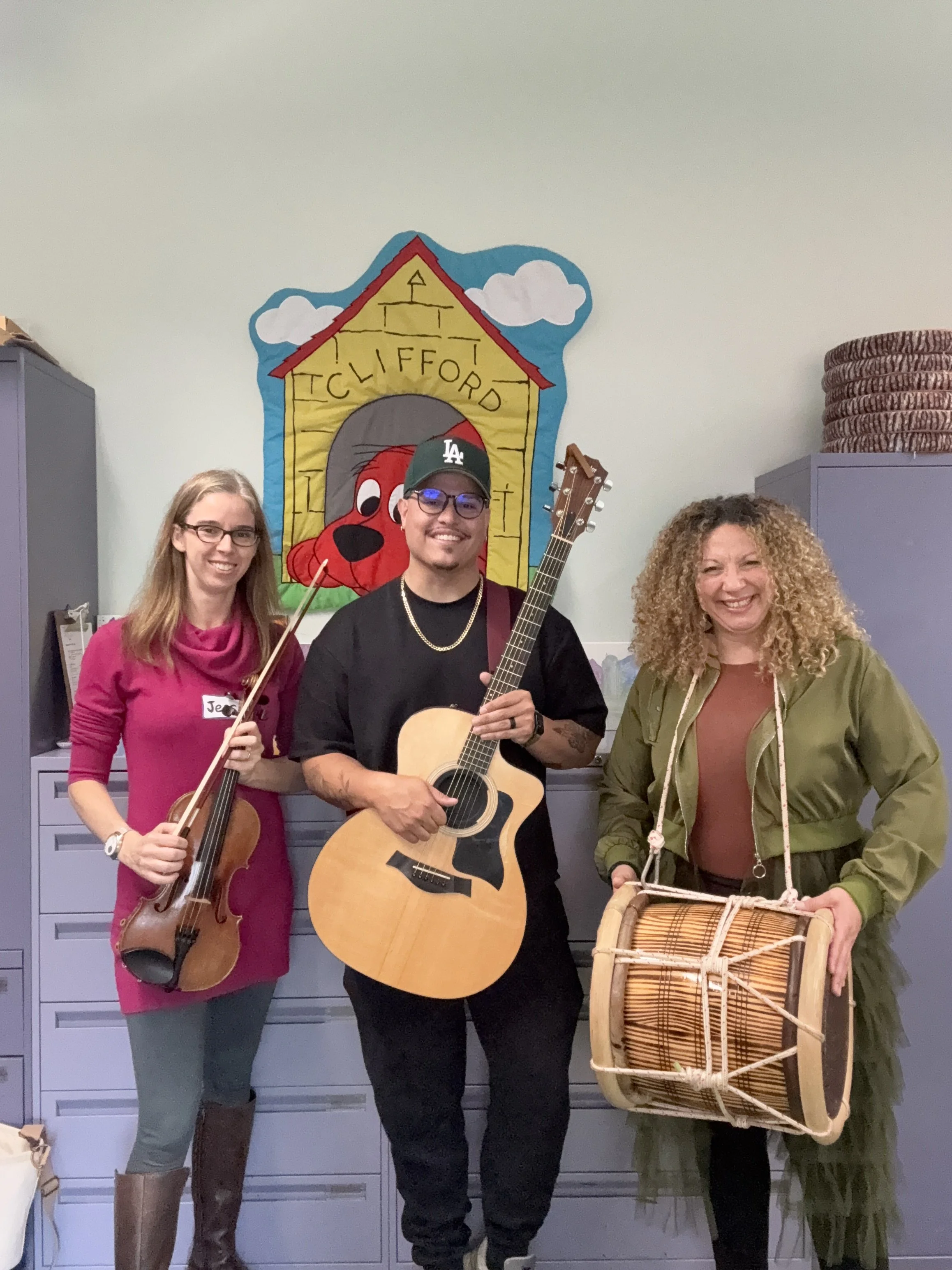
The Texture Tones Trio at the Springfield Public Library
One thing we didn’t plan but turned out to also be very helpful for the comfort of our audience was having toys available. One of our newest (not yet released!) songs is about flying on a rocket ship, and we had a few dozen 3d printed music shakers in the shape of rocket ships, designed by our teammate, music therapist Jen Kass. Arguably the best feature of this design is the hidden undercarriage cutout that makes them stackable, but slightly wobbly. People of all ages enjoy creating and balancing towers of rockets, and/or knocking them to the ground. Early-arriving audience members were invited to play with these while waiting, and after we did the rocket song in performance, we let children continue playing with them during other songs if they wished.
So what was the impact of these performances? I was deeply touched by a note from one parent (who is a music teacher who has done multiple PDs with us!). “Jess, this was an amazing experience for our whole family! [Child] had a wonderful time (even if his face doesn’t always show it) and it was the first time we’ve been able to take him to a performance and feel totally welcome! I loved all the songs and ways the kids were included!” Another family brought their child who is a wheelchair and AAC user. They seemed pleasantly surprised that we presumed competence and spoke directly to their child, were prepared with choice boards and choice cards as communication tools for engagement, and automatically assumed that we would clear a path for the wheelchair to maneuver through the room for musical participation and movement. Another autistic child was most comfortable observing the event from just outside the room, seated on his father’s lap and watching through the doorway. Every time there was an activity with shakers or scarves or making a supported choice, we brought those opportunities to him. At one point he was able to verbally request to use cards instead of a full choice board, and we were happy to oblige!
It has been only a few days since these concerts, but in the intervening time I saw a social media post by DisabilityArts that had different and related concert inclusion ideas more targeted toward neurodivergent adults, which I would like to highlight. One great suggestion was to provide a set list with timing, which is functionally a visual schedule for the concert (click here for our blog post on visual schedules and their benefits). In fact, at one of our performances last week we had an older youth who saw the hard copy of our set list and asked if she could take a look at it, then proceeded to ask follow-up questions about upcoming songs. We were happy to answer them so that she felt secure about what was going to happen.
DisabilityArts also provides a recorded social story that alerts audience members to the great flexibility that they will have to stim and move around– I appreciate that they provided this information in advance as an audio recording and not just as printed text! This is a great Universal Design approach.
One other thing that DisabilityArts highlighted about their practices that I find brilliant is the provision of an “accessibility box.” Not only does this have (adult-centered) sensory tools similar to ours, it also has earplugs (appropriate for adults but not children), face masks for the medically vulnerable (even if you bring your own, sometimes they break or get snot in them!), lyric books for accessing the song content, and pronoun pins so that everyone’s identity is affirmed. The next time we have an opportunity to give sensory concerts, I am going to come back to this blog post to be reminded of these ideas so that we can implement them in audience-appropriate ways, improving our inclusion and accessibility. Thank you, DisabilityArts!
Medley staff and friends are often available to provide sensory-inclusive concerts and adaptive music classes in the Connecticut River Valley area of Western Massachusetts. Please email Jess at jc@music-access.com to inquire.