
Inclusion Means Belonging, Not Sameness: Thoughts on school concerts
Click here to hear this post in Jess’ voice.
We hear regularly from elementary music teachers who are in a dilemma about how to facilitate disabled students’ participation in school concerts. These situations almost always involve children who struggle with impulse control and self-regulation. Their self-soothing behaviors might feel disruptive to others. The concerts involve performance skills that are not within the disabled child’s interests and abilities, but admin or parents want them to participate, because that is “inclusion”.
Is that really inclusion? We would argue that it is not. It is trying to fit a child into a box that wasn’t built for them.
True inclusion means belonging as you are– not sameness.
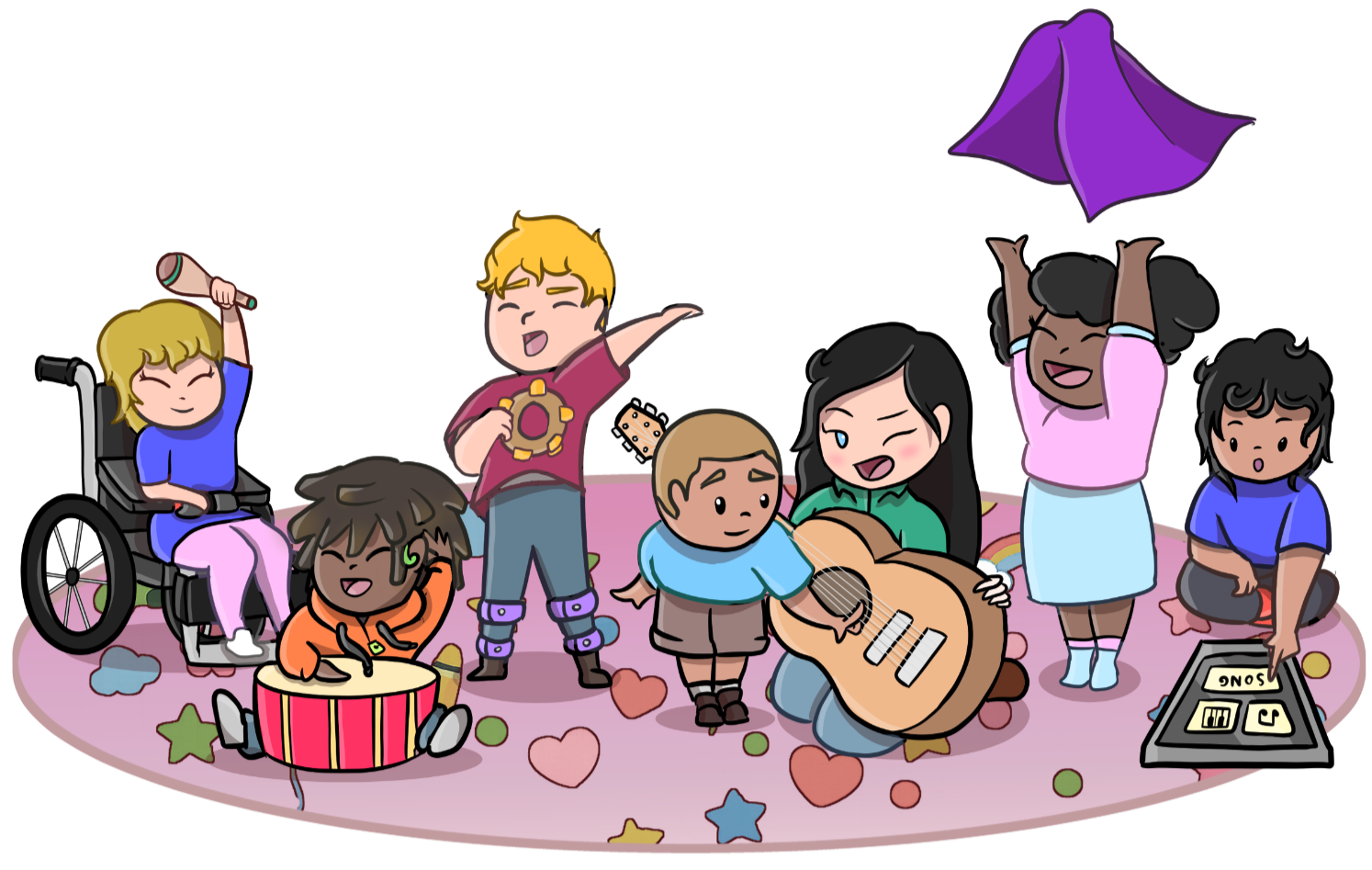
Isaiah Eddington’s cover art for We Are All Musicians, showing a diverse music class.
School concerts are generally modeled on European concert hall performances. A group of performers appears on a stage (or equivalent), facing an audience that is larger in number, performing music and/or dancing that has been prepared to a certain standard with audience entertainment as one prioritized goal. Entertainment is certainly not the only goal in a school concert; students are sharing what they have learned in music classes, and they are learning in the moment about performance conventions and their own responses and capacity as performers. Different schools and events may have different expectations about the formality of “concert behavior,” event execution, and audience response and involvement, but the basic format is relatively consistent.
Here’s the important thing to remember about inclusion: the learning environment and performance expectations need to meet the student’s interests and abilities, otherwise the child will not be meaningfully included. They may be physically included, but this is not the same thing as creating true belonging as their authentic self.
If you have, for example, an autistic student who experiences and externalizes distress due to unpredictability, new experiences, proximity to crowds, enforced stim suppression/standing still, rigid performance expectations, and intense sensory experiences, there is no possible combination of accommodations that will make a traditional school concert format align with their needs. Even the best social story ever written can’t prepare you for the actual experience of having hundreds of eyes looking at you and expecting you to give a specified performance on command. And you know what? That’s okay! European-style performance is not a requirement for a child to grow as a musician, have meaningful musical experiences at school, or belong to their school community. What we need to do in these cases is reimagine our concept of sharing musical experiences with the community beyond our music class members, and build new experiences around the real-time interests and abilities of the students we have right now. This may be a difficult reality for school communities who have longstanding and beloved concert traditions. Change is hard, but our kids are worth it.
So what are some options for reimagining? Here are a few ideas to consider as starting points.
Smaller, more intimate events. The more people present, the more stimulation and unpredictability must be endured. Making the gathering smaller also allows it to take place in a familiar space like the student’s homeroom or music classroom, reducing cognitive demands. Maybe the event involves the child’s whole class, or maybe it’s even smaller. Maybe you can arrange a music sharing event with the child’s parents, two close classmates, and the trusted school counselor. It doesn’t have to be big to be meaningful, but it can still be a celebration of developmentally-appropriate musical performance.
Less-formal events. I’m a fan of informances that are basically demo music classes, where students run through their familiar music class routine with caregivers observing, and students sit in a familiar circle facing each other rather than the audience. Or maybe the “concert” is more participatory than performance-focused, where students and other audience members all engage in singing and moving as a community, even while physically intermingled. This helps children with high support needs avoid the demand of being in the spotlight and commanded to perform, yet they can experience the specialness and joy of community music-making, all while accessing accommodations with relative anonymity.
Sharing through video recording. There may be no way to manage the sensory experience of having live audience members that doesn’t trigger significant distress for some students. If you use this model, please do everything you can to obtain the child’s informed consent for making the recording, not just guardian permissions.
We would argue that reimagining events is the most inclusive way to meet the needs of all students, but there remain many potential barriers to implementation, including the expectations of other well-intentioned but misunderstanding adults. If your principal is insisting on having students with high support needs participate in a major concert, here is what we would try to do.
First, and most importantly, consult with the child’s Special Education teacher and the rest of their support team. These other teachers spend more hours with the student every week and see them across a broader range of contexts than the music teacher so they will have a better understanding of the child’s total interests and abilities. You want to be on the same page with them, especially if you end up proposing something that does not match your principal’s initial expectation and request. Discuss: what challenges is this child likely to face when participating in the concert? How will they react? What can we do to reduce their likely distress? What supports can we provide to promote their success? What “success” would the child value most?
If you modify the performance to match their interests and abilities, don’t isolate them in that experience. Make their engagement mode(s), like signing, instruments, or movement available to other students as an option for the performance as well. You may need to limit the number of children in a role rather than making it available to everyone, but it’s important that it is open to more students than just those of a specific profile.
Incorporate as much flexibility as possible. If it matches the student’s interests and abilities, can they perform from a location other than center stage, maybe at the edge of the stage, in the wing, or from the floor? This should be an option only if it facilitates their comfort performing, not enforced as a method of isolation or changing the experience for other performers. Offer the student choices about how they will participate, reiterating that they will have all of these choices still available to them if they need to change their mind on the day of or during the concert.
Have a contingency plan. Concerts are exciting and stimulating events. Even with extensive planning and supports in place, the student may still experience overload and melt down. How can they signal a preemptive need to leave? Who will help them manage it? Where will they re-regulate? Using what tools and strategies?
While it is unquestionably appropriate to plan a community music experience for the students as they are right now, it is also appropriate to work at building skills in the long term to support future performance. For many children this means building self-advocacy skills, self awareness, and a sense of autonomy– and arts classrooms are an optimal place to develop these abilities. Ensure that you have an inclusive classroom environment throughout the school year that welcomes students to be their authentic selves, struggles and all, and it may just quietly build the foundation that students need for participating differently in concerts in the future.